The German Marshall Fund of the United States Erasmus Funded Brussels Trainee

Job Summary:
The German Marshall Fund of the United States, Brussels Office is accepting on a rolling basis traineeship applications to help with its programming activities. Candidates must be eligible for Erasmus + program funding provided by their universities, or other similar grants through their governments/national institutions . Learn more about the Erasmus + funding opportunity by the European Commission here (http://ec.europa.eu/programmes/erasmus-plus/index_en.htm) and consult your university.
It is the candidate’s responsibility to inquire with their university regarding eligibility prior to applying for the position.The German Marshall Fund of the United States_ does not bear any responsibility in initiating the Erasmus + funding procedure._
The trainee will work closely with senior GMF staff to provide research, logistical and administrative support. Trainees will be on flexible work plans where they assist multiple programs based on their background and interests and the program’s availability and needs.The traineeship is a unique opportunity to be in close contact with the international policy community. Trainees can benefit from the Brussels environment and attend various EU related events. Trainees will also receive insights into office administration, database and events logistics.
Candidates must be eligible for Erasmus+ program funding, or other similar grants.
Key Areas of Responsibility:

  • Providing administrative and operational support for the GMF Brussels office programing on issues pertaining to EU affairs, transatlantic relations and foreign policy;
  • Assisting in the organization and coordination of Brussels based events, as well as broader GMF convening activities;
  • Conducting background research and writing internal memos for various projects;
  • Preparing talking points and preparatory materials for GMF fellows and senior staff ahead of meetings and speaking engagements;
  • Helping maintain the Brussels office’s and relevant program’s database of contacts;
  • Assisting with administrative and logistical duties as assigned.

Qualifications and Requirements:

  • Academic background in international relations and/or European studies, with at least a fully completed bachelor’s degree;
  • Strong interest in transatlantic policy issues;
  • Familiarity with European institutions desired;
  • Fluency in English. Second language skills in French, German or a third European language is a plus;
  • Excellent written and oral communication skills;
  • Proficiency with Microsoft Office (Word, Excel, and Outlook) is essential;
  • Flexibility to multi-task, have an eye for detail, ability to perform under tight deadlines and work independently;
  • Previous experience in a think tank, foundation, NGO, government body, media outlet, or similar organization desired, but not required;
  • Experience in event management is a plus;
  • Good interpersonal skills and ability to work in a multicultural environment.
  • *Start and Length of Traineeship:

GMF’s Brussels office offers three starting dates for traineeships:

  • January (Winter Selection) – Deadline for application: October 1
  • May (Spring Selection) – Deadline for application: February 1
  • September (Fall Selection) – Deadline for application: June 1

Candidates can only apply to one selection period at a time, to be explicitly mentioned in the application. All traineeships last 6 months.
Due to the high volume of responses, we will only contact candidates of interest.
GMF is an Equal Opportunity Employer.


Apply Here

Internship European External Affairs

Looking for a challenging internship in European External Affairs starting around January, February or March 2022. It’s time to apply!


Who are we?

At Unilever, we share one simple purpose: To make sustainable living commonplace. Through our powerhouse brands such as Dove, Axe and Magnum, we are creating a bright future for our business and our planet –and you can be part of it!

We believe that companies with purpose last, people with purpose thrive and brands with purpose grow. We meet everyday needs for nutrition, hygiene and personal care with brands that help people feel good, look good and get more out of life.

Main purpose of theinternship:

We are looking to recruit an energetic intern in our European External Affairs Office in Brussels to support the team in driving this agenda at the EU institutions and other European stakeholders.

Working in the field of Foods & Refreshment, Home Care and Beauty & Personal Care – Unilever’s three core businesses – the intern will contribute to:

  • Performing background research and analysis on emerging issues;
  • Performing research and analysis on the position and activities of key stakeholders;
  • Monitoring regulatory, legislative and political processes of interest to Unilever;
  • Drafting advocacy materials, press reviews and organizing events.

The intern will have the opportunity to:

  • Be exposed to the functioning of a fast-moving and multi-sectoral international company;
  • Contribute to the challenges and opportunities in integrating sustainability into our business;
  • Experience the importance of public affairs, both in terms of challenges and opportunities, for the achievement of Unilever’s vision: Doubling the size of ourbusiness whilst reducing our overall environmental impacts across the entire value chain;
  • Learn from a team of experienced public affairs practitioners, working on a wide variety of current and emerging issues;
  • Drive your own projects within the context of the European External Affairs team responsibilities, based on (developed) personal interest.

What we ask:

  • The internship must take place in the framework of a University degree, ideally a Master’s degree in European Law, International Politics, European Studies or equivalent
  • The intern must be registered as a student during the whole duration of the internship
  • English fluently written and spoken is a must, good knowledge of Dutch, French or German would be an asset
  • The internship would last for a duration of about 6 monthsfull-time(orat least 32 hours a week)
  • You are a team player with a strong sense of responsibility
  • You are a self-starter, able to work autonomously
  • You are able to work with a diversity of people and teams

What we offer:

  • An outstanding chance to bring our unique purpose to life!
  • An opportunity to take a look behind the scenes at one of the biggest FMCG-corporations in the world.
  • An opportunity to learn from a variety of concrete projects.
  • Lots of responsibility, but also good guidance during your internship.

EXCITED ABOUT THE ROLE?

To apply, please send your CV and a motivation letter where your preferred internship topics, internship duration and ideal start date are highlighted.

Source: https://www.glassdoor.com/Job/brussels-international-affairs-internship-jobs-SRCH_IL.0,8_IC2302160_KO9,41.htm

European Astronaut Centre (EAC), Space Medicine Team – Internship opportunities

Location(s)

France

Based at the European Astronaut Centre (EAC), ESA’s Space Medicine Team comprises medical doctors, biomedical engineers, exercise physiologists, psychologists, IT specialists, education coordinators, administrators and project managers. Each plays a vital role in ensuring the health and well-being of astronauts during all stages of a mission.

To better support astronauts during current missions to the International Space Station and prepare for human missions beyond low Earth orbit, the Space Medicine Team is working to identify, evaluate and develop new space technologies and procedures.

This process involves collaborating with ESA’s technology teams and Human Research Office to identify existing space-relevant technologies and scientific knowledge, and looking outside of ESA at terrestrial technology developments and the wealth of current science knowledge concerning human health.

To achieve their goal, the Space Medicine Team works in close partnership with national space agencies, industry, research institutions and universities from across ESA’s Member States. The team also regularly coordinate workshops for the next generation of space physicians.

Internship opportunities

In support of the space medicine team, and international space medicine, REDI (Research, Education & Development Initiative) through academic collaboration and educational partnerships seeks to promote technical (research and development), and individual (education and training) readiness for current, and future human space missions.

As part of this initiative, we offer a limited number of internship places each year to students of medicine, the biomedical sciences (including exercise science) or biomedical engineering and – where appropriate – those with specific expertise in analytics/programming or educational/outreach.

Our internship projects may involve the collection and/or the analysis of medical/research data (in collaboration), performance of systematic literature reviews, elements of medical hardware evaluation/development, database management, or the generation of analytical models/simulations.


Our internships are within the following domains:

  • Identification and evaluation of medical risks (including radiation) associated with Low Earth Orbit and Deep Space vehicles/habitats.
  • Optimisation of in-flight exercise countermeasures (for ISS and Exploration).
  • Evaluation and optimisation of non-exercise management of astronaut health.
  • Identification, development, validation and implementation of medical technologies and strategies to mitigate medical risks associated with spaceflight.
  • Optimisation of post-flight rehabilitation strategies.
  • Evaluation of the suitability and applicability of ground-based analogues of micro- and hypogravity.
  • Identification and evaluation of medical risks and requirements associated with hypogravity (lunar) operations.
  • Development, delivery and accreditation of international space medicine education/training.

In order to optimise productivity and applicability, we encourage the use of a range of open-source tools. Please highlight in your application if you have expertise/experience in the use of:

  • Rayyan: for systematic reviews.
  • Mendeley: for Citation management.
  • Python(or MatLab, R or SPSS): for data/statistical analysis.
  • OpenSim/Anybody: for biomechanical simulation.

In addition, please highlight any experience in educational/outreach delivery/development, database management, programming or physiological data capture/analysis.

Students of medicine should note that the space medicine team is not a clinical environment, and that due to the highly confidential nature of our flight surgeons’ activities, it is not possible to involve students in day-to-day astronaut medical support.

The minimum duration of an internship with the space medicine team is three months. However, six-month internships are considered optimal.

Deadline: November 30, 2022

Cost/funding for participants

Fully Funded


Source: https://www.heysuccess.com/opportunity/European-Astronaut-Centre-(EAC)-Space-Medicine-Team-Internship-opportunities-57829

31st European regional conference of the International Telecommunications Society

31st European regional conference of the International Telecommunications Society

Reining in Digital Platforms? Challenging monopolies, promoting competition and developing regulatory regimes

20th –22nd June 2022, Gothenburg, Sweden

There are many benefits associated with ICT. The pandemic has vividly demonstrated the benefits of ICT, which enabled many activities to go online. Without widespread ICT availability and adoption, it would not have been possible for large parts of economies to work from home or for students to be educated online . And online shopping, which among other things has allowed groceries to be ordered remotely, has grown in popularity in many countries. Quite simply, without ICT the pandemic would have been very different experience.

But there are also problems. Many ICT markets are highly concentrated, with one large company dominating the market. These ‘winner takes all’ (or most) markets are driven by network effects and scale economies, where large numbers of users generate competitive advantages that are difficult for rivals to overturn. It is perhaps no surprise that four out of the five most valuable companies globally are technology based, with Apple and Microsoft currently being capitalised at over $2 trillionaire apiece. The growth of Amazon, which has catapulted its founder, Jeff Bezos, to become the world’s richest man, overtaking another tech company founder in the process.

As tech companies have grown and increased in value, the resources available to them have multiplied. Many of the leading tech companies have engaged in frequently and ambitious M&A activity, acquiring through what is often described as a ‘Pac man’ strategy their rivals, actual or potential. Through these purchases tech companies have sought to entrench their positions, thereby strengthening their dominance in markets.

Over the years, tech companies have attracted considerable attention. Their tax arrangements have been criticised, especially in those countries where they have grown at the expense of local companies or where they are viewed as not contributing their ‘fair share’ of taxes. The new global framework, co-ordinated by the OECD, appears to be a step in the right direction when it comes to addressing the concerns of government, but it is too early to tell whether it address the concerns of others.

And their business models have come under intense scrutiny. The European Union has, in recent years, imposed fines on Alphabet due to its anti-competitive behaviour. While these fines amount to almost €10 billion, they are dwarfed by the financial resources available to Alphabet – this throws into doubt their effectiveness in changing’s Alphabet’s behaviour. In the UK, the initial enquiry by the Competition & Markets Authority into Facebook’s purchase of Giphy found that it could harm competition. The on-going in-depth review of the purchase could force Facebook to sell the company to someone else. In the United States, the House Judiciary Committee in 2020 suggested structural separation as one of the tools though which the anti-competitive nature of the big tech business models could be checked.

Data is at the heart of the business models of many big tech companies. Through collecting, combining and analysing data from multiple sources in unprecedented amounts, big tech companies have been able to develop innovative services that are popular with users. But increasingly individuals are concerned about the data they are providing and how it is being used, frustrated by their inability to control who has access to it and how it is used. Governments have sought to provide those who provide data with greater control over it, but differences exist between counties in how they treat data. But what else can governments do? Can data interoperability be implemented, thereby allowing users to switch between companies, or can greater control be given to data providers?

Governments are also developing policies to capture the benefits of the data based economy that is emerging. Industrial policies are emerging that seek to provide countries with the necessary digital infrastructure, thereby enhancing the country’s competitiveness. Some of these policies have focused on the physical infrastructure, such as fibre roll-out or cloud computing, while

Governments have also sought to develop policies to capture the benefits of the data based economy that is emerging. Industrial policies are emerging that seek to provide countries with the necessary digital infrastructure to enhance their competitiveness, with some initiatives focusing on the physical infrastructure while others have concentrated on data. In an increasingly global economy, are individual countries able to improve their cloud or data sovereignty? Are some policies better suited to enhancing a country’s competitiveness?

As big tech comes under greater scrutiny, a number of questions emerge. Should big tech companies be broken up? If so, how should they be broken up and which governments should take the lead? If they are not to be broken up, what should governments do instead? Does a series of new regulatory tools and approaches need to be developed, and then implemented in a co-ordinated (global) approach by governments? Or should governments and regulators concentrate on data, focusing on enhancing user privacy or providing them with greater control over their data.

We welcome submissions on ‘digital platforms’ in terms of the regulatory and competitive challenges that they pose, and how they may be addressed in a post-Covid world. In addition, we welcome submissions on a range of topics as outlined below:

  • The current and lasting impact of Covid-19 on telecommunications networks, different industries and users
  • The roll-out of 5G and the emergence of (innovative) business models
  • The Internet of Things – verticals, innovative business models and revenue sources
  • Digital divides – their changing nature and how they can be overcome
  • Digital skills – identifying and then providing the skills needed to participate online, for individuals and businesses
  • The use of ICT by marginalised groups
  • Operator strategies – bundling, fixed-mobile and content-telecommunications convergence
  • The role of consumers within telecommunications markets
  • OTT – strategies and impact on the telecommunications sector
  • The socio-economic impact of new technologies (e.g., IoT, AI, blockchain)
  • Greening the ICT sector – strategies, regulation and the impact of technological innovation
  • The role of ICT in addressing and achieving Sustainable Development Goals
  • The scope and nature of universal service in telecommunication markets
  • Innovative ways of providing telecommunications infrastructure in remote and rural areas
  • Standards within telecommunication markets
  • Equipment suppliers – supply chain dynamics, Open RAN and 5G

Submissions addressing any other subject relating to telecommunications technologies and markets are also welcome. Theoretical and empirical papers are welcome, as are methodologically qualitative and quantitative papers.

Important dates:

 7 January 2022: Deadline for abstracts and panel session suggestions
 1 February 2022: Notification of acceptance
 16th May 2022: Early registration deadline
 10th June 2022: Deadline for final papers
 19th June 2022: Welcome receptione
 20th – 22nd June 2022: Conference

We hope to offer a face-to-face conference next year. Given the current uncertainties, a final decision will be made in early-2022.

Submission of abstracts:

Abstracts should be about 2 pages (800 to 1000 words) in length and contain the following information:

  • Title of the abstract / panel session
  • A clear statement of the research question
  • Remarks on the methodology adopted in the paper
  • Outline of (expected) results
  • Bibliographical notes (up to 6 key references used in the paper)

Abstracts should be submitted via EasyChair.

If you do not already have an account, you will need to create one. Existing accounts can be used to submit your abstract.

Please submit your abstract via:

https://easychair.org/conferences/?conf=its2022

ll abstracts will be subject to blind peer review.

Call for Papers: Central European Economic Journal

Call for Papers: Central European Economic Journal

Gender and Parenthood in the context of Public Policy

Deadline

Tue, 03/15/2022 – 12:00

Motivation

Women in different countries face different challenges in the labour market due to historical, institutional, and cultural specificities. For this reason, policies which were successful in improving gender equality in one country might not bring the desired outcomes in another country. To tailor labour market policies, it is important to gain an accurate picture of how the historical, institutional, and cultural characteristics impact the effectiveness of various policies aimed at decreasing gender inequalities. With this call for papers, they invite research which addresses the situation of women in the labour market of different countries, paying special attention to the factors which influence women’s employment, occupation, and earnings. They welcome empirical research addressing any aspect of these relationships that contributes to our knowledge of these phenomena and has relevant implications for regional policymaking. Single country as well as comparative studies are welcome with a special focus on Central and Eastern European countries, which display growing heterogeneity in women’s performance in the labour market and which are still poorly understood.

Why submit to the CEEJ?

Central European Economic Journal publishes original theoretical and empirical research papers in the field of economics as well as at the intersection of economics and sociology, demography, political science, law and management. The journal accepts papers which fall under (but are not restricted to) the following research areas: macro- and microeconomics, labour market research, international trade, population studies, public sector economics, public policies, health, gender, ecological economics, finance, accounting, managerial economics. CEEJ addresses the broad international community, but especially welcomes papers which focus on socio-economic problems relevant for Central and Eastern Europe, including the European transition countries.

  • The CEEJ is an open access, double-blind peer-reviewed journal, free of charge, available at the Sciendo/DeGruyter Open Platform and at www.ceej.wne.uw.edu.pl . The CEEJ offers:
  • Open access to all published articles;
  • Transparent, comprehensive and fast double-blind peer-review process;
  • Convenient and widely known web-based manuscript submission and tracking system (ScholarOne);
  • Access to an efficient route for fast-tracking publication, taking full advantage of Sciendo’s publishing platform with language verification;
  • Free submission of papers and no charge for the article processing charges (APCs).

Submission

To submit your manuscript, use their ScholarOne system  https://mc.manuscriptcentral.com/ceej

In the cover letter inform them that your manuscript is submitted as part of Call for Papers with Guest Editors Anna Lovasz and Barbara Pertold-Gebicka.

The deadline for submitting papers is 15th March 2022

Each article should be prepared in accordance with the guidance given in the “Instructions for Authors” section of their website: http://ceej.wne.uw.edu.pl/for-authors/ If you have any questions, don’t hesitate to contact Guest Editors: Anna Lovasz: plovi@uw.edu or Barbara Pertold-Gebicka: gebicka@fsv.cuni.cz or CEEJ Editorial Office: ceej@wne.uw.edu.pl

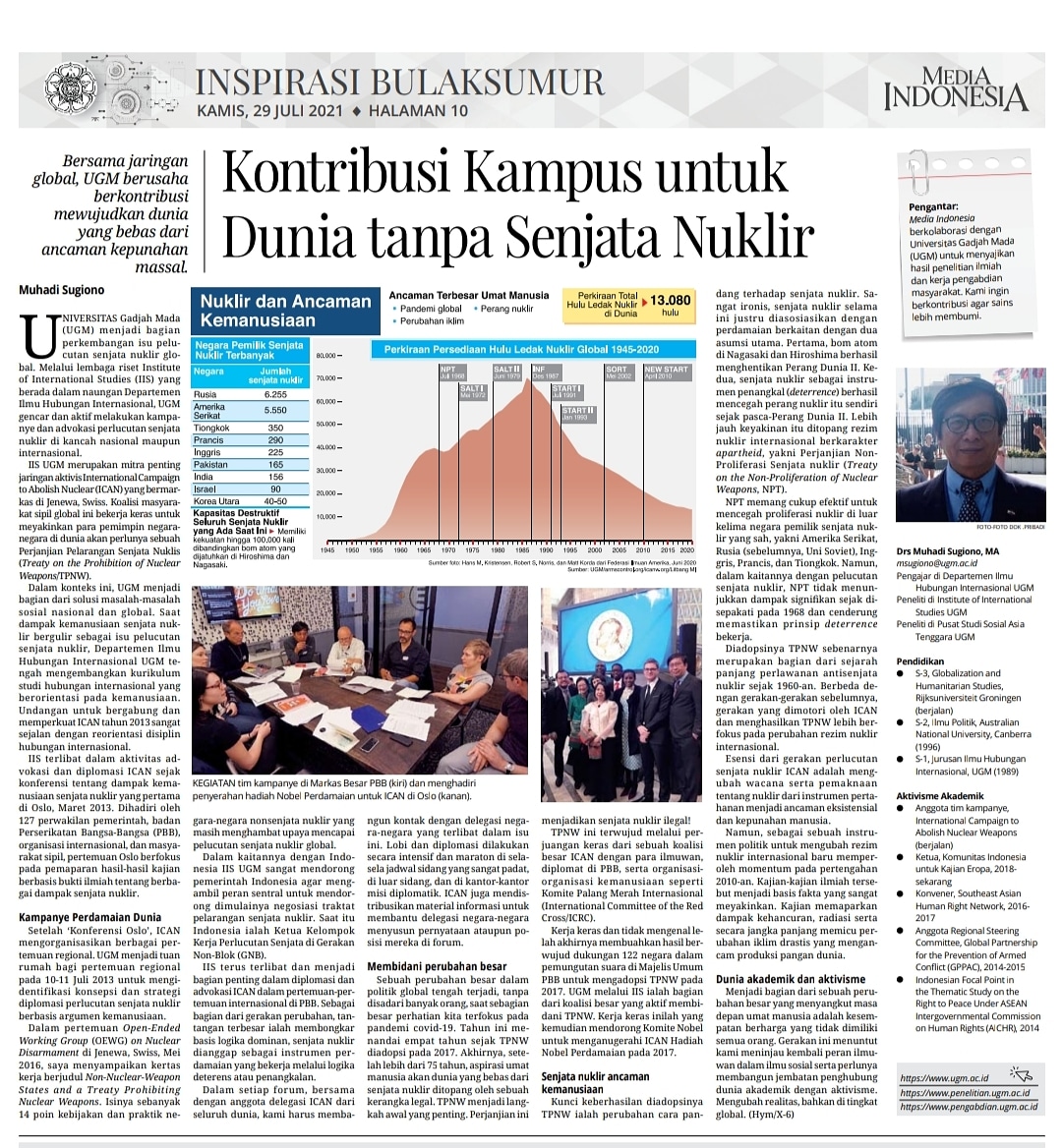
Kontribusi Kampus untuk Dunia Tanpa Nuklir

Penulis: Muhadi Sugiono
Universitas Gadjah Mada
Email: msugiono@ugm.ac.id


Eropanisasi

Muhadi Sugiono
Universitas Gadjah Mada
Email: msugiono@ugm.ac.id

Uni Eropa sering digambarkan sebagai entitas yang sui generis. Sebagai sebuah entitas politik, Uni Eropa adalah gabungan karakter dari dua institusi yang sangat berbeda, jika bukan bertolak belakang, yakni institusi supranasional dan organisasi internasional. Label sui generis ini  muncul karena ketidakmungkinan untuk mengidentikkannya sebagai sebuah entitas supranasional ataupun sebagai sebuah organisasi internasional. Tetapi, karakter sui generis ini cenderung tidak muncul dalam diskusi tentang Uni Eropa. Politik Uni Eropa cenderung tetap dipahami melalui dua cara yang berbeda (Hix and Høyland 2011, 16-18). Mereka yang sangat optimis memahami Uni Eropa melalui kerangka supranasionalisme. Supranasionalisme menggambarkan Uni Eropa sebagai sebuah entitas yang independen yang bukan hanya memiliki kepentingan yang mungkin sangat berbeda dari kepentingan negara-negara anggotanya, tetapi juga memiliki kekuasaan atas negara-negara anggotanya. Implikasinya, kebijakan-kebijakan yang dibuat oleh Uni Eropa berlaku untuk negara-negara anggota Uni Eropa serta warga negara mereka. Sebaliknya, bagi mereka yang pesimis, Uni Eropa berkembang sebagai konsekuensi dari interaksi kepentingan di antara negara-negara anggota-anggotanya. Uni Eropa tidak akan pernah menjadi entitas supranasional yang mandiri dari negara-negara pembentuknya. Dengan kata lain, Uni Eropa semata-mata merupakan arena bagi negara-negara anggotanya untuk mengejar kepentingan mereka. Kebijakan yang diambil oleh Uni Eropa adalah produk dari negosiasi kepentingan negara-negara anggotanya. Pandangan yang kedua ini dikenal sebagai intergovernmentalisme.

Berkembangnya konsep Eropanisasi (Europeanization) pada pertengahan tahun 1990-an memberikan alternatif yang lebih proporsional untuk menjelaskan bagaimana Uni Eropa sebagai entitas sui generis bekerja. Konsep ini menghubungkan dua realitas kekuasaan, yakni Uni Eropa dan negara-negara anggotanya, yang saling mempengaruhi. Konsep Eropanisasi berangkat dari asumsi bahwa integrasi regional yang berkembang ke dalam bentuk Uni Eropa menjadikan proses politik di Eropa berbeda. Eropanisasi menggambarkan penetrasi kebijakan Uni Eropa ke dalam sistem politik negara-negara anggotanya. Tetapi, konsep Eropanisasi tidak mengasumsikan adanya hubungan kekuasaan yang unilinear antara Uni Eropa dan negara-negara anggotanya. Uni Eropa memiliki pengaruh yang besar di negara-negara anggotanya, tetapi bukan yang menentukan. Negara-negara anggota Uni Eropa berperan besar dalam menentukan apakah kebijakan Uni Eropa akan diadopsi, diubah atau ditolak. Dengan kata lain, penetrasi Uni Eropa ke negara-negara anggotanya bukan sebuah keniscayaan. Pada saat yang sama, hubungan kekuasaan antara Uni Eropa dan negara-negara anggotanya adalah hubungan interaksi timbal balik dan saling mempengaruhi. Negara-negara anggota Uni Eropa bukan sekedar penerima kekuasaan Uni Eropa, tetapi juga memanfaatkan Uni Eropa untuk mendukung atau memperkuat kebijakan nasional mereka.

Eropanisasi dan integrasi Eropa

Eropanisasi merupakan konsep yang berkembang pesat pada tahun 1990-an. Tetapi, sekalipun telah menjadi sangat populer dalam kajian Eropa, Eropanisasi merupakan konsep yang sangat diperdebatkan dan dipahami dengan cara yang sangat berbeda (Olsen 2002, 921; Radaelli 2000). Signifikansi Eropanisasi sebagai sebuah konsep untuk menjelaskan sebuah fenomena juga tidak jarang dipertanyakan. Keragaman pemahaman terhadap Eropanisasi menjadikannya sangat lentur sebagai sebuah konsep dan cenderung kehilangan fokus.[1]

Meskipun demikian, Eropanisasi bukan sebuah konsep yang tidak bermanfaat. Terlepas dari perbedaan pemahaman mengenai konsep ini, Eropanisasi merupakan konsep yang sangat bermanfaat dalam konteks perubahan di Eropa dengan munculnya Uni Eropa sebagai sebuah sistem governance. Dalam artian ini, Eropanisasi sebagai sebuah konsep yang menggambarkan bagaimana Uni Eropa sebagai sebuah sistem governance berpengaruh terhadap politik di negara-negara anggotanya (Hix and Goetz 2000, 1). Munculnya konsep ini bukan hanya menggambarkan reorientasi kajian Eropa yang selama ini berfokus pada upaya untuk menjelaskan proses integrasi, munculnya sistem governance di tingkat regional serta kebijakan-kebijakan yang dihasilkan oleh sistem tersebut, tetapi juga mencerminkan ‘transformasi’ Eropa yang dihasilkan oleh proses integrasi (Cowles, Caporaso and Risse 2001).

Sebagai fenomena yang menggambarkan kompleksitas dinamika interaksi antara Uni Eropa dengan negara-negara anggotanya, Eropanisasi jelas sangat terkait dengan integrasi Eropa. Minat terhadap Eropanisasi berkembang seiring dengan semakin terintegrasinya Eropa. Oleh karenanya, bagi banyak ilmuwan kajian Eropa, fenomena Eropanisasi harus dipahami dalam kerangka besar studi tentang integrasi di Eropa. Graziano dan Vink menggambarkan munculnya minat terhadap Eropanisasi sebagai ‘The Europeanization Turn’ dalam kajian Eropa. Konsep Eropanisasi membuka ruang analisis untuk melihat interaksi antara politik di level nasional dan politik di level regional yang cenderung diabaikan dalam kajian Eropa yang hingga pertengahan tahun 1990an didominasi terutama oleh upaya-upaya untuk menjelaskan proses integrasi (Graziano and Vink 2012, 33).  Tidak jauh berbeda dari Graziano dan Vink, James Caporaso juga mengkaitkan Eropanisasi dengan integrasi di Eropa. Konsep Eropanisasi berkembang dalam konteks perkembangan kajian Eropa tentang integrasi yang berlangsung dalam tiga tahap.[2] Tahap pertama adalah yang memusatkan pada penjelasan tentang munculnya dorongan untuk membangun kerjasama antar negara. Fokus kajian pada tahap ini adalah pada negara untuk menemukan faktor-faktor yang mendasari kemauan negara untuk bekerjasama. Pada tahap kedua, orientasi kajian Eropa berubah secara drastis, seiring dengan semakin menguatnya institusionalisasi kerjasama di tingkat regional dan berkembangnya Uni Eropa sebagai sebuah entitas politik ataupun bahkan sebuah sistem politik yang ditandai dengan meningkatnya kompetensi Uni Eropa untuk menghasilkan kebijakan-kebijakan. Kajian Eropa pada tahap ini berfokus pada upaya untuk memahami bagaimana Uni Eropa sebagai sebuah sistem bekerja. Konsep Eropanisasi berkembang sebagai bagian dari perkembangan kajian integrasi pada tahap ketiga, yakni yang memberikan perhatian pada bagaimana dampak keberadaan Uni Eropa bagi negara-negara anggotanya, yakni yang telah berkontribusi untuk membentuk Uni Eropa (Caporaso 2008).

Eropanisasi sebagai Proses Top-Down

Konsep Eropanisasi yang dipahami secara spesifik dalam kaitannya dengan integrasi Eropa pada dasarnya mencakup tiga proses, yakni yang dikenal sebagai proses top-down, proses bottom-up dan proses horizontal. Tetapi, sebagian besar pemahaman konsep Eropanisasi cenderung melihat proses top-down, yakni terkait dengan bagaimana sistem governance di Eropa berpengaruh terhadap sistem di negara-negara anggota Uni Eropa. Dengan melihatnya sebagai ‘sebuah lensa teoretis tentang dampak dari integrasi terhadap struktur domestik,’ misalnya, Radaelli secara jelas menggambarkan Eropanisasi sebagai hubungan kausal yang bersifat top-down antara Uni Eropa dan negara-negara anggotanya (Radaelli 2006, 58).[3]

Dalam proses yang top-down ini, Eropanisasi berawal dari semakin terkonsolidasinya Uni Eropa baik dalam artian institusi, mekanisme maupun norma. Konsolidasi di tingkat regional ini menimbulkan persoalan dalam kaitannya dengan kesesuaian (fits) atau ketidaksesuaian (misfits) antara sistem governance regional dengan sistem governance nasional. Besarnya tekanan Eropanisasi sangat ditentukan oleh tingkat kesesuaian ataupun ketidaksesuaian kedua sistem governance: semakin besar ketidaksesuaian di antara keduanya, semakin besar tekanan terhadap sistem nasional untuk melakukan perubahan dan penyesuaian. Tekanan penyesuaian terhadap sistem governance regional ini yang kemudian mendorong perubahan dalam sistem nasional ke arah regional (Börzel and Risse 2000, 59).

Banyak contoh yang ditunjukkan terkait dengan Eropanisasi sebagai sebuah proses yang berlangsung secara top-down ini. Dalam bidang moneter, misalnya, setelah ditandatanganinya Perjanjian Maastricht pada tahun 1992, Uni Eropa memberikan tekanan yang kuat kepada negara-negara anggotanya untuk menyesuaikan sistem moneter nasionalnya sebagai prasyarat untuk bisa diterima ke dalam Economic and Monetary Union (EMU). Prasyarat ini menempatkan negara-negara anggota Uni Eropa dalam kedua kategori di atas, yakni sesuai dan tidak sesuai. Sistem moneter Jerman, yang memiliki bank sentral yang independen (Bundesbank) adalah negara dengan sistem keuangan yang paling sesuai dengan prasyarat yang dituntut oleh Uni Eropa, sementara Perancis adalah negara yang paling tidak sesuai, karena bank sentralnya (Banque de France) yang cenderung di bawah kendali negara. Konsekuensinya, dalam artian proses, tekanan Eropanisasi terhadap Perancis jauh lebih kuat daripada tekanan terhadap Jerman.

Proses Eropanisasi yang berlangsung secara top-down seperti yang digambarkan oleh Radaelli secara jelas menggambarkan pengaruh Uni Eropa terhadap perubahan-perubahan yang dilakukan di tingkat nasional oleh negara-negara anggotanya. Konsep kesesuaian dan ketidaksesuaian antara sistem nasional dengan sistem regional menggambarkan bahwa perubahan di tingkat nasional secara jelas berasal dari eksternal, yakni Uni Eropa. Yang menarik, proses Eropanisasi ini terjadi bukan hanya di bidang-bidang yang cenderung dianggap low politics, tetapi juga di bidang-bidang dalam kategori high politics atau yang sangat menyentuh privilege negara-negara anggota Uni Eropa karena menyangkut kedaulatan (Wallace 2000, 369-82). Dalam kategori ini, menarik melihat bagaimana UnI Eropa berperan besar dalam mengubah kebijakan nasional misalnya yang terkait dengan mata uang, pertahanan dan keamanan, dan perbatasan. Berbagai contoh perubahan terhadap bidang-bidang yang tadinya menjadi privilege negara-negara berdaulat ini tentu saja bertolak belakang dengan pandangan neofungsionalisme yang cenderung melihat kerjasama antar negara bisa berjalan jika dimulai dengan kerjasama-kerjasama yang bersifat fungsional.

Tentu saja, Eropanisasi dalam artian proses yang top-down semakin nampak dalam kaitannya dengan perluasan keanggotaan Uni Eropa. Negara-negara calon anggota Uni Eropa dari Eropa Timur harus melakukan serangkaian penyesuaian dalam kebijakan nasionalnya sesuai dengan permintaan Uni Eropa yang tercantum dalam Copenhagen Criteria. Keinginan negara-negara tersebut untuk bergabung ke dalam Uni Eropa memberikan Uni Eropa posisi yang sangat kuat untuk menuntut perubahan di negara-negara tersebut (Schimmelfennig and Sedelmeier 2005). Eropanisasi benar-benar telah membentuk lembaga dan kebijakan negara-negara yang akan bergabung dengan Uni Eropa.

Eropanisasi sebagai proses yang timbal balik

Eropanisasi sebagai proses top-down secara jelas menggambarkan pengaruh Uni Eropa terhadap negara-negara anggotanya. Sekalipun terlihat sangat kuat, Eropanisasi sebenarnya bukan hanya melibatkan proses top-down atau proses downloading melainkan juga proses yang sebaliknya, yakni bottom-up ataupun uploading (Quaglia, Neuvonen, Miyakoshi and Cini, opcit,  406). Eropanisasi tidak terjadi sebagai refleksi dari hubungan kekuasaan yang asimetris atau yang menggambarkan tekanan sepihak dari Uni Eropa kepada negara-negara anggotanya, melainkan sebagai produk dari hubungan timbal balik. Eropanisasi melibatkan proses internal di tingkat nasional disamping proses eksternal yang berupa tekanan dari Uni Eropa. Dengan kata lain, Eropanisasi adalah sebuah proses timbal balik.

Studi yang dilakukan oleh Schimmelfennig dan Sedelmeier terkait dengan keinginan negara-negara di Eropa Tengah dan Timur untuk menjadi anggota Uni Eropa sebenarnya secara jelas menggambarkan proses dua arah ini (Schimmelfennig and Sedelmeier 2005, 1). Kemampuan Uni Eropa untuk memaksakan perubahan di negara-negara tersebut untuk memenuhi Copenhagen Criteria bukan semata-mata mencerminkan kekuasaan Uni Eropa atas negara-negara ini. Kemampuan Uni Eropa menjadi tidak bermakna jika negara-negara tersebut tidak berkeinginan untuk menjadi anggota negara-negara Uni Eropa. Dalam artian ini, pertimbangan-petimbangan nasional di negara-negara tersebut yang berupa peluang ekonomi yang dijanjikan oleh Uni Eropa maupun meningkatnya leverage negara-negara tersebut di dunia internasional sebagai bagian dari Uni Eropa menjadi faktor penting bagi negara-negara tersebut untuk menerima tuntutan Uni Eropa akan transformasi sistemik di negara-negara tersebut (Wallace 2000, 1).

Eropanisasi sebagai sebuah proses dua arah jelas menggambarkan eksistensi kedaulatan negara-negara anggotanya. Dalam konteks ini, Eropanisasi bukan hanya sejalan dengan kepentingan negara-negara anggotanya tetapi tidak jarang juga berlangsung sebagai bagian dari strategi negara untuk meraih keuntungan dari keberadaan Uni Eropa. Kesediaan negara-negara eks Eropa Tengah dan Timor untuk melakukan transformasi sistem sebagai strategi untuk memperoleh keuntungan dari keberadaan Uni Eropa bukan kasus yang eksklusif. Negara-negara yang lebih besar seperti Jerman, Perancis dan Inggris juga memanfaatkan keberadaan Uni Eropa dan keanggotaannya di dalam Uni Eropa untuk mencapai atau setidaknya mendukung pencapaian tujuan nasionalnya.

Keanggotaan Jerman di Uni Eropa, misalnya, bukan hanya menguntungkan Jerman secara ekonomi, tetapi juga secara politik terkait dengan tujuan kebijakan luar negerinya ke arah negara-negara Eropa Timur (Anderson and Goodman 1997, 51). Kepentingan nasional juga tercermin dalam kesediaan Perancis untuk melakukan reformasi terhadap Bank Sentralnya yang cenderung digambarkan sebagai produk dari tekanan Uni Eropa sebagai syarat bagi Perancis untuk bergabung ke dalam EMU. Seperti yang ditunjukkan oleh Anderson and Goodman, Perancis sangat berkepentingan untuk mendorong terbentuknya EMU sebagai strategi untuk mengurangi dominasi Jerman dalam kebijakan ekonomi Uni Eropa, terutama karena besarnya pengaruh Bundesbank dalam Sistem Moneter Eropa (Anderson and Goodman 1997, 52).

Daftar kasus yang menggambarkan Eropanisasi bukan semata-mata mencerminkan kekuasaan Uni Eropa atas negara-negara anggotanya, melainkan juga produk dari strategi negara-negara anggotanya untuk menggunakan Uni Eropa untuk mencapai kepentingan mereka bisa sangat panjang. Tetapi, kasus-kasus tersebut secara jelas memperkuat argumen bahwa Eropanisasi berlangsung sebagai proses dua arah. Negara-negara anggota mengunggah (proses uploading) kebijakan dan tujuan kebijakan nasionalnya ke tingkat regional dan menjadikan sistem governance di tingkat regional tersebut sebagai sarana untuk mendukung tujuan nasional mereka tersebut. Disamping itu, pembuat kebijakan juga menjadikan Eropanisasi sebagai sarana untuk mencapai kepentingan-kepentingan domestik mereka (Börzel 2002, 194).

Eropanisasi sebagai proses horizontal

Di luar proses yang berlangsung secara top-down dan bottom-up ataupun sebagai proses downloading ataupun uploading, Eropanisasi juga berlangsung secara horizontal (Radaelli 2006, 62). Proses ini menggambarkan bagaimana negara-negara anggota menggunakan Uni Eropa sebagai platform kebijakan untuk memperkuat pengaruhnya ke negara-negara anggota yang lain. Menurut Börzel, Schimmelfennig dan Sedelmeier, Eropanisasi sebagai proses horizontal ini biasanya dimulai oleh negara-negara anggota Uni Eropa yang lebih mapan untuk mempengaruhi negara-negara anggota yang lain yang lebih lemah (Börzel 2002; Schimmelfennig and Sedelmeier 2005).

Contoh yang seringkali ditunjukkan untuk menggambarkan proses Eropanisasi horizontal adalah kebijakan lingkungan. Meningkatnya kesadaran akan lingkungan di negara-negara anggota Uni Eropa yang mapan seperti Jerman, telah mendorong negara-negara tersebut untuk mempengaruhi kebijakan tentang lingkungan di Uni Eropa. Dorongan untuk mengunggah kebijakan nasional negara-negara tersebut ke tingkat regional adalah untuk menghindarkan dampak ekonomi dari kebijakan lingkungan di negara tersebut. Karena kebijakan yang berorientasi pada lingkungan akan cenderung menjadikan produk-produk dari negara-negara tersebut tidak cukup bersaing dengan negara-negara lain, maka memaksa negara-negara lain untuk juga meningkatkan kepedulian mereka terhadap lingkungannya menjadi satu pilihan yang menarik. Untuk tujuan tersebut, Uni Eropa menjadi platform yang sangat strategis. Eropanisasi dalam proses ini, oleh-karenanya berlangsung dalam dua proses, yakni bottom-up (uploading) dari negara-negara anggota ke Uni Eropa, kemudian top-down (downloading) dari Uni Eropa ke negara-negara yang lain.

Eropanisasi horizontal ini tidak dapat diabaikan pengaruhnya dalam politik di Eropa. Munculnya Uni Eropa sejak awal merupakan produk dari kepentingan nasional yang diproyeksikan ke sistem Eropa dan kemudian mempengaruhi sistem nasional negara-negara lain. Proses ini terlihat misalnya dalam kebijakan kerjasama pembangunan Uni Eropa. Pengaruh negara-negara eks kolonial terhadap kebijakan Uni Eropa dalam kerjasama pembangunan sangat besar dan menjadi bagian dari kebijakan yang diikuti oleh negara-negara anggota Uni Eropa yang lain. Contoh lain yang sangat mencerminkan Eropanisasi horizontal adalah kecenderungan ke arah standarisasi di Uni Eropa. Munculnya kecenderungan ini antara lain disebabkan oleh proses Eropanisasi horizontal ini. Bahkan, upaya standarisasi yang dilakukan melalui Uni Eropa tidak hanya berpengaruh terhadap negara-negara anggota ataupun calon anggota Uni Eropa, tetapi juga terhadap negara-negara lain di luar Uni Eropa. Pengaruh Uni Eropa di luar sistem Eropa berlangsung melalui hubungan bilateral maupun multilateral. Penandatanganan Persetujuan Kemitraan Sukarela terhadap Forest Law Enforcement, Governance and Trade (FLEGT VPA), sebuah inisiatif dari Uni Eropa untuk mengurangi pemnebangan liar dengan memperkuat keberlanjutan dan legalitas pengelolaan hutan, memperbaiki pengelolaan hutan serta mendorong perdagangan kayu yang diproduksi secara legal, oleh lebih dari 16 negara di dunia, misalnya, menggambarkan Eropanisasi melampaui batas-batas sistem governance Uni Eropa (European Commission 2019).

Penutup

Eropanisasi merupakan konsep yang berkembang dan sangat populer dalam kajian Eropa pada tahun 1990-an. Popularitas konsep ini menjadikan banyak orang meragukan kegunaan konsep ini sebagai kerangka analisis. Memang, adanya penafsiran yang beragam terhadap konsep ini menjadikannya sulit untuk membantu memfokuskan diri pada aspek tertentu dalam kajian Eropa. Tetapi, bab ini cenderung melihat konsep Eropanisasi merupakan konsep yang sangat bermanfaat untuk menjelaskan bagaimana bekerjanya Uni eropa sebagai sebuah entitas sui generis, yang terbentuk dari dua realitas kekuasaan yang berbeda. Sekalipun tidak ada perbedaan signifikan terkait dengan karakter sui generis Uni Eropa, menjelaskan bagaimana entitas dengan karakter ini bekerja cenderung diabaikan. Adalah dalam kerangka ini, Eropanisasi menjadi sebuah konsep yang sangat membantu.

Eropanisasi dalam tulisn ini dipahami secara khusus dalam kaitannya dengan integrasi Eropa. Dalam artian ini, Eropanisasi menggambarkan perubahan politik di Eropa dengan munculnya Uni Eropa sebagai sebuah sistem governance.  Sebagai sistem governance, keberadaan Uni Eropa sangat mempengaruhi proses nasional di negara anggotanya. Tetapi, pengaruh Uni Eropa terhadap sistem di negara-negara anggotanya bukan sebuah proses unilinear (top-down), melainkan sebuah proses dua arah (top-down dan bottom up). Disamping itu, Eropanisasi juga berlangsung sebagai sebuah proses horizontal.

Referensi

Anderson, J.J. and Goodman, J.B. (1997). Mars or Minerva?  A United Germany, dalam Keohane, R.O., Nye, J.S. and Hoffman, S. eds. After the Cold War: International Institutions and State Strategies in Europe, 1989-1991. Harvard University Press, 23-62.

Börzel, T.A. (2002). Pace-Setting, Foot-Dragging, and Fence-Sitting: Member State Responses to Europeanization. Journal of Common Market Studies, 40 (2), 193-214.

Börzel, T.A. and Risse, T. (2000). When Europe Hits Home: Europeanization and Domestic Change. European Integration Online Papers, 4(15), 29 November.  Tersedia online di http://eiop.or.at/eiop/texte/2000-015a.htm

Bulmer, S. and Burch, M. (1998). Organizing for Europe: Whitehall, the British State and European Union. Public Administration 76 (4), 601-628

Caporaso, J. (2008). The Three Worlds of Regional Integration Theory, dalam Graziano, P.R. and Vink, M.P. (eds) Europeanization: New Research Agenda. Palgrave Macmillan, 23-34.

Cowles, M.G., Caporaso, J.  and Risse, T. eds. (2001). Transforming Europe : Europeanization and Domestic Change. Cornell Studies in Political Economy. Cornell University Press

Diez, T. and Wiener, A. (2009). Introducing the Mosaic of Integration Theory, dalam Anja Wiener dan Thomas Diez, eds.  European integration theory (2nd ed.). Oxford University Press, 1-24.

European Commission (2019) FLEGT Regulation — FLEGT Voluntary Partnership Agreements (VPAs), tersedia online https://ec.europa.eu/environment/forests/flegt.htm.

Goetz, K.H. and Hix, S. eds. (2000). Europeanised Politics? : European Integration and National Political Systems. Ser. West european politics, 23 (4).

Graziano, P.R. and Vink, M.P. (2012). Europeanization: Concept, Theory, and Methods, dalam Bulmer, S. & Lesquene, C. (eds), The Member States of the European Union. Oxford University Press, 32-54.

Hix, S. and Goetz, K.H. (2000).  Introduction: European Integration and National Political Systems. West European Politics 23 (4), 1-26.

Hix, S. and Høyland, B.K. (2011). The political system of the European Union. Palgrave Macmillan.

Ledrech, R. (1994). Europeanization of Domestic Politics and Institutions: The Case of France. JCMS: Journal of Common Market Studies 32 (1), 69-88.

Olsen, J. P. (2002). The Many Faces of Europeanization. JCMS: Journal of Common Market Studies 40 (5), 921-952.

Quaglia, L., Neuvonen, M., Miyakoshi, M. and Cini, M. (2007). Europeanization, dalam Cini, M. ed. European Union Politics, 2nd edn. Oxford University Press, 405-420.

Radaelli, C.M.  (2000). Whither Europeanization: Concept Stretching and Substantif Change. European Integration Online Paper 4 (8), tersedia online di http://eiop.or.at/eiop/pdf/2000-008.pdf

Radaelli, C.M. (2006). Europeanization: Solution or Problem?, dalam Michelle Cini and Angela K Bourne. Palgrave Advances in European Union Studies. Palgrave Advances. Palgrave Macmillan, 56-76.

Schimmelfennig, F.  and Sedelmeier, U. (2005). Introduction: Conceptualizing the Europeanization of Central and Eastern Europe, dalam Schimmelfennig, F.  and Sedelmeier, U., eds. The Europeanization of Central and Eastern Europe. Cornell University Press, 1-28.

Wallace, H. (2000). Europeanisation and Globalisation: Complementary or Contradictory Trends?. New Political Economy 5 (3), 369–382.


Versi akhir artikel ini terbit dalam volume EU: Institution, Politik dan Kebijakan, yang disunting oleh Muhadi Sugiono, Graha Ilmu, 2019.


[1] Reorientasi fokus kajian Eropa terlihat misalnya melalui karya-karya Ledrech (1994), Bulmer and Burch (1998), Goetz and Hix (2000).

[2] Tentang tiga tahap perkembangan teoretis untuk menjelaskan integrasi Eropa, lihat juga Diez and Wiener (2009).

[3] Eropanisasi sebagai proses yang top-down juga seringkali dikenal sebagai proses downloading karena menggambarkan dua hubungan kausal dari dua tingkatan yang berbeda, yakni regional ke nasional. Lihat Quaglia, Neuvonen, Miyakoshi and Cini (2007, 406).

Eropa dan Studi Hubungan Internasional

Muhadi Sugiono
Universitas Gadjah Mada
Email: msugiono@ugm.ac.id

Mengapa mempelajari Eropa? Apakah masih relevan belajar Eropa saat ini? Pertanyaan-pertanyaan ini, ataupun pertanyaan-pertanyaan lain yang senada, sering diajukan. Beberapa perkembangan yang terjadi baik di Eropa maupun di luar Eropa memang cenderung mendorong banyak orang untuk memandang Eropa dengan skeptis. Saat ini, Uni Eropa tengah dilanda berbagai krisis. Proyek integrasi, yang telah memberikan inspirasi kepada banyak kawasan yang lain, dianggap mengalami kegagalan. Krisis ekonomi, krisis pengungsi serta meningkatnya perlawanan terhadap Uni Eropa di banyak negara anggota, yang sering diidentikkan dengan euroskeptisme, yang secara ekstrim ditunjukkan dengan keluarnya Inggris dari Uni Eropa,  dianggap sebagai indikasi-indikasi dari kegagalan integrasi sebagai sebuah proyek politik. Pada saat yang sama, dominasi Uni Eropa sebagai representasi Eropa terancam dengan kebangkitan Rusia di bawah Putin yang juga berusaha memperluas pengaruhnya di kawasan tersebut. Penguasaan kembali Krimea oleh Rusia mencerminkan upaya Rusia untuk menunjukkan eksistensinya sebagai sebuah kekuatan besar, setidaknya dalam percaturan politik di Eropa. Dan sekalipun belum menghasilkan persaingan dengan skala Perang Dingin, kebangkitan Rusia dan upayanya untuk memperluas pengaruhnya di Eropa menunjukkan adanya kontestasi terhadap identitas dan tatanan politik di Eropa. Disamping itu, perkembangan geopolitik ke arah Asia (Asian Century) serta rivalitas Cina dan Amerika dianggap semakin menyingkirkan atau setidaknya memarginalkan Eropa dalam politik internasional.

Sekalipun tidak dapat dipungkiri bahwa kebangkitan Asia dan meningkatnya rivalitas antara Amerika dan Cina saat ini semakin cenderung ‘menyandera’ perhatian dunia dari Eropa, kebutuhan untuk mempelajari Eropa dalam Hubungan Internasional tidak dapat diabaikan. Eropa lebih daripada sekedar kategori geografis (kawasan). Dalam sejarah, dinamika yang ada di Eropa memiliki pengaruh dan dampak yang besar keluar dari batas-batas geografis Eropa. Pengaruh dan dampak dinamika yang terjadi di Eropa masih berpengaruh sampai saat ini. Disamping itu, kehadiran Uni Eropa memungkinkan pengkaji hubungan internasional untuk berpikir keluar dari kerangka politik kekuasaan.


Dinamika dan Pengaruh Global Eropa

Eropa seringkali dipahami sebagai sebuah realitas baik dalam artian historis, kultural, geografis maupun sebagai sebuah identitas. Tetapi, pemahaman ini tentu saja sangat menyesatkan. Sebagai kata yang sering kita gunakan tanpa kita merasa perlu mempertanyakannya, Eropa sebenarnya bukanlah sebuah realitas tunggal dan baku, melainkan sebuah realitas yang sangat beragam dan kompleks, yang selalu berubah dan direka ataupun direka ulang. Mungkin karakter-karakter ini tidak eksklusif Eropa. Tetapi, karakter-karakter ini menjadi menarik dalam kaitannya dengan Eropa setidaknya karena dua hal. Pertama, sejarah Eropa menunjukkan adanya pola yang menarik yang ditandai dengan dinamika hubungan antara krisis dan transformasi sebagai produk dari penyelesaian krisis. Kedua, pengaruh dari dinamika yang terjadi tidak terbatas secara geografis di Eropa tetapi juga menyebar ke berbagai belahan bumi yang lain.

Eropa adalah sebuah paradoks  (Jarausch 2015, 1-2). Eropa menggambarkan dua sisi yang sangat bertentangan. Di satu sisi, Eropa identik dengan peradaban modern yang menawarkan semua kemajuan. Di sisi lain, Eropa juga identik dengan barbarisme yang tercermin antara lain melalui terjadinya Holocaust dan kolonialisme. Dua sisi Eropa ini berinteraksi dan membentuk sejarah Eropa yang sangat dinamis. Dinamika politik di Eropa ini tercermin dengan jelas misalnya dalam sejarah diplomasi di Eropa. Melalui perspektif Hegelian, A.J.P. Taylor dalam bukunya Struggle for the Mastery of Europe, 1848 – 1918, menggambarkan diplomasi Eropa yang berlangsung sejak munculnya gelombang revolusi 1848[1] sebagai sebuah pola perubahan yang terus menerus atau berulang hingga mencapai klimaksnya dengan pecahnya Perang Dunia I, ‘[N]o war is inevitable until it breaks out’  (1954, 518). Dilihat dengan cara ini, tatanan politik di Eropa sangat dinamis. Secara bergantian Eropa dilanda berbagai krisis seperti perang-perang besar dan berkepanjangan serta menikmati masa-masa damai setelah berhasil mengatasi krisis-krisis tersebut. Krisis dan upaya penyelesaian terhadap krisis menjadi bagian penting yang membentuk dinamika politik di Eropa. Setidaknya, hingga Perang Dunia II, transformasi tatanan politik di Eropa selalu diawali dengan krisis-krisis besar.

Yang menarik, krisis dan penyelesaian krisis di Eropa seringkali memiliki pengaruh yang sangat besar hingga keluar dari batas-batas geografi Eropa. Institusi negara-bangsa yang menjadi basis dalam hubungan internasional hingga saat ini berkembang di Eropa sebelum akhirnya menyebar ke seluruh penjuru dunia dan menjadi aspirasi bagi gerakan-gerakan untuk menentukan nasib sendiri (Bull and Watson 1984). Kemunculan negara-bangsa sebagai sebuah konsep sangat erat terkait dengan Perjanjian Westphalia, yang dimaksudkan untuk mengakhiri Perang Tiga Puluh Tahun di dalam Kekaisaran Romawi Suci antara 1618-1648. Perjanjian Wina adalah contoh lain dari upaya penyelesaian krisis di Eropa dengan pengaruh yang sangat signifikan dalam hubungan internasional. Keberadaan lima anggota tetap Dewan Keamanan PBB dengan hak veto sebagai privilege merupakan manifestasi dari sistem konser, yakni koalisi negara-negara besar, untuk menjamin perdamaian di Eropa pasca penaklukkan Napoleon (Bosco 2011, 440).

Dinamika tentu saja bukan karakter eksklusif politik di Eropa. Tetapi, pengaruh yang melampaui batas-batas geografisnya, menjadikan dinamika politik di Eropa sangat unik. Sejarawan Julio Crespo MacLennan bahkan lebih tegas lagi menyebut tidak lagi Eropa mempengaruhi dunia, tetapi ‘membentuk’ dunia modern (MacLennan 2018). Ada beberapa faktor yang ada di Eropa, yang tidak dimiliki oleh kawasan lain, yang membentuk peran unik Eropa di dunia modern. Pengaruh Eropa di dunia bermula dari ekspansi dan pendudukan teritorial di wilayah-wilayah di luar Eropa, kemudian diperkuat dengan pengaruh politik, ekonomi, kultural dan bahkan spiritual Eropa serta dengan perpindahan serta bermukimnya orang-orang Eropa di wilayah-wilayah yang didudukinya (MacLennan 2018, x-xi). Tetapi, besarnya pengaruh Eropa juga memiliki akar dalam gerakan intelektual di Eropa pada abad ke 17 dan 18 yang menyatukan gagasan-gagasan mengenai Tuhan, nalar, kemanusiaan dan alam ke dalam sebuah pandangan dunia yang berorientasi pada rasionalitas, kapitalisme, individualisme dan aturan hukum tercermin melalui berbagai bidang mulai dari seni, filsafat hingga politik. Gerakan intelektual yang dikenal sebagai Pencerahan (Enlightenment) ini yang memungkinkan modernisasi berkembang di Eropa.[2]

Pengaruh Eropa terhadap dunia tidak hanya terjadi saat Eropa mengalami perkembangan atau kemajuan. Krisis yang terjadi di Eropa juga memiliki pengaruh yang sangat besar bagi dunia. Dua perang besar di abad ke-20 dan dikenal sebagai Perang Dunia I dan II adalah perang-perang yang mencerminkan dinamika politik di Eropa tetapi menyeret seluruh dunia ke dalamnya. Di samping itu, munculnya negara-negara baru dari wilayah-wilayah jajahan Eropa sejak berakhirnya Perang Dunia II sangat dimungkinkan dengan menurunnya kekuasaan negara-negara Eropa dan krisis imperialisme yang terjadi di Eropa. Kehadiran negara-negara pasca kolonial ini mengubah secara drastis peta politik dunia pasca Perang Dunia II, dari sebuah masyarakat yang sebagian anggotanya adalah negara-negara Eropa menjadi masyarakat yang mayoritas anggotanya adalah negara-negara dari luar Eropa (Seth 2000).


Uni Eropa

Berkembangnya Uni Eropa semakin memperkuat argumen tentang pentingnya mempelajari Eropa, terutama bagi ilmuwan Hubungan Internasional. Pertama, berkembangnya Uni Eropa sebagai produk dari sebuah evolusi panjang yang bermula dari pembentukan European Coal and Steel Community (ECSC) pada tahun 1952 menandai terjadinya perubahan signifikan dalam penataan politik di Eropa.  Pembentukan ECSC menandai terbentuknya tatanan politik di Eropa yang tidak lagi di bangun di atas prinsip perimbangan kekuasaan dan kompetisi antar negara tetapi di atas prinsip kerjasama dan supranasionalisme. ECSC memungkinkan dua kekuatan yang selalu bermusuhan satu sama lain, Jerman dan Perancis, untuk bekerjasama dalam pengelolaan batu bara dan baja. Pada saat yang sama, keberadaan institusi supranasional yang dikenal dengan High Authority dengan karakter supranasionalnya merupakan sebuah terobosan yang tak terbayangkan dalam politik di Eropa yang cenderung menempatkan negara sebagai pemilik kedaulatan yang absolut. Dalam artian ini, integrasi di Eropa seringkali dipahami sebagai sebuah proyek perdamaian (Hermawan 2019).

Kedua,  Uni Eropa menjadi representasi penting Eropa terutama dalam hubungan internasional. Kata Eropa seringkali dipahami sebagai sebuah konsep yang kohesif baik sebagai geografi, kultur, tradisi pemikiran ataupun peradaban. Pemahaman ini sangat menyesatkan karena pada dasarnya Eropa sangat terpecah-pecah secara internal seperti antara lain tercermin melalui dinamika yang digambarkan pada bagian sebelumnya. Para pemimpin Eropa pendukung integrasi membayangkan Uni Eropa sebagai jawaban terhadap sebuah pertanyaan penting dalam kaitannya dengan representasi Eropa, ‘Who speaks for Europe?’ (Pattison 1978).[3] Memang, Uni Eropa dan Eropa adalah dua hal yang berbeda. Tetapi, perluasan keanggotaannya hingga ke negara-negara Eropa timur dan tengah menjadikan Uni Eropa saat ini mewakili lebih dari 60% negara-negara di Eropa.[4]

Ketiga, Uni Eropa membangkitkan kembali Eropa sebagai sebuah identitas bersama. Identitas Eropa menjadi agenda politik yang sangat penting. Identitas Eropa, dalam pandangan Presiden Dewan Eropa 2009-2014, Herman van Rompuy akan menjadikan Eropa sebagai ‘Eropa’ kembali (Agence Europe 2014). Proses integrasi, termasuk perluasan keanggotaan ke negara-negara Eropa Timur dan Tengah, memberi kontribusi yang sangat besar bagi terciptanya identitas kolektif ini (Spohn & Eder 2016). Pada saat yang sama Uni Eropa secara aktif mengkonstruksi nilai-nilai ke-Eropa-an. Identitas Eropa menjadi agenda resmi Uni Eropa pada tahun 1970an dengan ditandatanganinya Declaration on the European Identity  pada pertemuan pertemuan puncak kepala negara dan pemerintahan di Copenhagen pada tanggal 14 Desember 1973. Tentu saja identitas Eropa bukan merupakan sebuah konsep yang tidak diperdebatkan atau dikontestasikan. Di satu sisi, bangkitnya kembali Rusia di bawah Putin secara jelas menimbulkan ancaman serius ide tentang Eropa yang tercermin melalui nilai-nilai yang dipromosikan oleh Uni Eropa (Mannin & Flenley 2018, h. 1). Rusia menjadi model alternatif bagi banyak negara Eropa, termasuk di antaranya adalah negara-negara anggota  Uni Eropa. Di samping itu, Uni Eropa sendiri secara internal tidak lepas dari ancaman kelompok-kelompok yang secara umum dikenal sebagai Euroskeptis. Kekuatan kelompok Euroskeptis sangat bervariasi dari satu negara ke negara lain. Tetapi, mereka telah mereka juga telah berkembang sebagai sebuah kekuatan bukan hanya di tingkat nasional, tetapi juga di tingkat regional.


Eropa, Studi Kawasan dan Ilmu Hubungan Internasional

Memahami dinamika yang terjadi di Eropa dan pengaruh global yang dihasilkan seperti dibahas di bagian sebelumnya membantu kita untuk memahami kawasan sebagai basis untuk menghasilkan pengetahuan dalam ilmu sosial. Kontestasi untuk menguasai, mendefinisikan atau mendefinisikan ulang Eropa, yang tidak jarang berlangsung dengan cara-cara yang penuh dengan kekerasan, menunjukkan bahwa Eropa adalah lebih merupakan sebuah ide daripada sebuah realitas fisik geografis baku. Sebagai sebuah ide, Eropa selalu berubah dan hadir dalam manifestasinya yang sangat berbeda.

Kajian-kajian tentang Eropa yang didasarkan pada pemahaman tentang Eropa sebagai sebuah idea dan bukan sekedar kategori geografis, menjadikan kajian Eropa sulit ditempatkan ke dalam studi kawasan (area studies), yakni sebuah disiplin yang berbasis interdisipliner yang berkembang pesat setelah Perang Dunia II. Didorong oleh kebutuhan strategis dalam persaingan dalam Perang Dingin, untuk menghasilkan ahli-ahli dan pengetahuan tentang kawasan-kawasan asing, studi kawasan dimaksudkan untuk memahami kehidupan politik, sosial, ekonomi maupun budaya dalam kaitannya satu sama lain dan meletakkan aspek-aspek tersebut dalam konteks yang sangat spesifik, yani kawasan (Clowes and Bromberg 2016, h. 4). Berbeda dengan konsep tentang Eropa yang lebih merupakan ide, kawasan dalam studi kawasan mengacu pada kategori baku geografis yang didefinisikan berdasarkan kepentingan strategis militer.

Berakhirnya Perang Dingin menjadikan minat dan dukungan terhadap studi kawasan mengalami penurunan secara signifikan. Secara akademis, karakter politik studi kawasan dan konsepsi kawasan sebagai sebuah konsep geografis yang baku juga semakin dipertanyakan. Tetapi, pada saat yang sama, kesadaran akan signifikansi kawasan bagi hubungan internasional semakin meningkat dengan berakhirnya Perang Dingin. Semakin banyak ilmuwan hubungan internasional melihat kawasan sebagai perspektif dan bukan realitas geografis untuk menjelaskan konflik dan kerjasama dalam hubungan internasional (Lake and Morgan 2007, h. 7). Perkembangan paling signifikan ditunjukkan oleh kajian-kajian keamanan dan ekonomi politik internasional. Konsep-konsep seperti kompleks keamanan regional (regional security complex) atau komunitas keamanan (security community) dalam kajian keamanan internasional (Buzan, Wæver, and Wilde 1998; Buzan and Wæver 2003; Katzenstein 2005 ) atau bagaimana globalisasi dibentuk oleh atau membentuk proses regionalisasi dalam kajian ekonomi politik internasional (Stubbs and Reed 2006), misalnya, adalah merupakan contoh-contoh meningkatnya perhatian ilmuwan hubungan internasional terhadap kawasan.

Kajian Eropa bisa menjadi referensi penting untuk mengembangkan kawasan sebagai sebuah perspektif, bukan kategori geografis, dalam studi hubungan internasional. Kajian-kajian tentang Eropa berkontribusi besar bagi perkembangan-perkembangan disiplin-disiplin dalam ilmu-ilmu sosial dan humaniora dan menghasilkan pengetahuan yang seringkali diperlakukan secara universal (Calhoun 2003, h. 5). Teori-teori integrasi, misalnya, berkembang dari pengalaman Eropa dengan regionalisme yang tidak hanya berfokus pada liberalisasi perdagangan sebagai produk dari negosiasi dan tawar menawar di antara negara-negara anggota Uni Eropa (Börzel 2013). Dari proses yang sangat spesifik Eropa, teori-teori integrasi menjadi basis teoritis untuk menjelaskan dan memahami kerjasama regional di berbagai kawasan.

Jika pemahaman mengenai kawasan yang membangun kajian Eropa ini digunakan untuk mengembangkan studi kawasan untuk kawasan-kawasan yang lain, kontribusinya bagi hubungan internasional tentu sangat signifikan. Mengintegrasikan studi kawasan dengan cara ini akan mengubah hubungan internasional menjadi disiplin yang lebih inklusif yang bisa merefleksikan suara dari mayoritas masyarakat dan negara di dunia yang selama ini cenderung terpinggirkan dalam disiplin hubungan internasional yang berkarakter Barat ataupun Amerika (Hoffman 1977).

Ini adalah tantangan besar bagi kurikulum studi hubungan internasional (Acharya 2014). Taruhannya sangat besar jika kita tidak menjawab tantangan ini.


Kajian Eropa dalam Kurikulum Studi Hubungan Internasional UGM

Kajian Eropa telah menjadi bagian dari kurikulum Studi Hubungan Internasional di Universitas Gadjah Mada (HI UGM). Tetapi, terdapat perkembangan, yang tidak selalu linear, dalam memahami Eropa dalam kurikulum HI UGM. Di awal perkembangannya, Eropa diperkenalkan sebagaimana kawasan-kawasan lain diperkenalkan, yakni dalam konteks studi kawasan. Eropa dilihat terutama melalui perspektif-perspektif sejarah dan komparatif seperti tercermin dalam mata-kuliah mata-kuliah Sejarah Diplomasi Eropa, Politik dan Pemerintahan Eropa dan Hubungan Internasional Eropa. Berkembangnya integrasi regional mendorong perubahan signifikan dalam pengajaran tentang Eropa di HI UGM. Eropa tidak lagi hanya dilihat melalui kacamata historis dan perbandingan politik, tetapi juga melalui perkembangan regionalisme di Eropa. Mata-kuliah mata-kuliah seperti Regionalisme Uni Eropa, Ekonomi Politik Regionalisme dan European Governance di samping mata-kuliah mata kuliah yang telah ada sebelumnya merupakan mata-kuliah mata kuliah yang memperkaya kajian Eropa dalam kurikulum HI UGM. Tetapi, pengayaan dan penguatan kajian Eropa dalam kurikulum HI UGM tidak mengubah karakter studi kawasan dalam memahami Eropa. Eropa dilihat sebagai sebuah kategori geografis dengan segala kekhasannya. Disamping itu, perhatian yang sangat besar terhadap integrasi Eropa cenderung mereduksi Eropa dengan Uni Eropa dan mengabaikan dinamika yang ‘membentuk’ Eropa. Konsekuensi dari pengabaian ini menjadi sangat terasa dalam kaitannya dengan berbagai krisis yang dihadapi oleh Uni Eropa.

Perubahan-perubahan kurikulum HI UGM membuka peluang untuk menata kembali kajian Eropa dengan melepaskan karakter studi kawasan dari kajian Eropa, yakni melihat Eropa sebagai sebuah ide dan bukan sekedar kategori geografis. Politik di Eropa dan Hubungan Internasional Eropa menjadi dua mata kuliah kajian Eropa yang ditawarkan dalam kurikulum HI UGM. Kedua mata kuliah ini dibangun dengan asumsi yang sangat berbasis pada ide. Politik di Eropa membahas mengenai kontestasi, definisi dan redefinisi Eropa yang berlangsung bukan hanya pada masa lalu tetapi juga saat ini. Fenomena-fenomena seperti menguatnya tantangan Rusia, aneksasi Krimea ataupun Brexit merupakan bagian dari proses kontestasi, definisi dan redefinisi Eropa yang terus berlangsung. Sementara itu, Hubungan Internasional Eropa membahas mengenai keberadaan Uni Eropa sebagai entitas sui generis dalam hubungan internasional dengan berbagai dampak dan implikasinya bagi pemahaman kita tentang hubungan internasional. Hubungan Internasional Eropa menunjukkan dua hal penting bagi studi hubungan internasional, yakni dalam kaitannya dengan keaktoran (actorness) dan dalam kaitannya dengan konsepsi tentang kekuasaan (power).[5] Keberadaan Uni Eropa menuntut pengkaji hubungan internasional untuk meninjau kembali konsep-konsep penting yang membentuk disiplin hubungan internasional.


Referensi

Acharya, A. (2014). Global International Relations (IR) and Regional Worlds: A New Agenda for International Studies. International Studies Quarterly, 58(4), 647–659.

Bosco, D. (2011). Uncertain Guardians: the UN Security Council’s Past and Future. International Journal, 66(2), 439–449.

Brunnstrom, D. (2009). EU Says It has Solved the Kissinger Question. Reuters, 20 November. Tersedia online di https://www.reuters.com/article/us-eu-president-kissinger-idUSTRE5AJ00B20091120

Bull, H. and Watson, A. eds. (1984). The Expansion of International Society. Clarendon Press.

Buzan, B. and Wæver, O. (2003). Regions and Powers – The Structure of International Security. Cambridge University Press

Buzan, B., Wæver, O. and Wilde, J. (1998). Security: A New Framework for Analysis. Lynne Rienner.

Börzel, T. A. (2013). Comparative Regionalism: European Integration and Beyond. Dalam Carlsnaes, W., Risse, T. and Simmons, B.A. eds. Handbook of International Relations. Sage, h. 503-530.

Calhoun, C. (2003). European Studies: Always Already There and Still In Formation. Comparative European Politics, 1, h. 5–20.

Clowes, E. W. and Bromberg, S. J. eds. (2016). Area Studies in the Global Age : Community, Place, Identity. NIU Press.

Godehardt, N. (2014). The Chinese Constitution of Central Asia : Regions and Intertwined Actors in International Relations (Ser. Politics and development of contemporary china ser). Palgrave Macmillan.

Hermawan, Y.P. (2019). Integrasi Eropa sebagai sebuah Proyek Perdamaian. Dalam Sugiono, M. ed. Uni Eropa: Institusi, Politik dan Kebijakan. Graha Ilmu.

Hoffmann, S. (1977). An American Social Science: International Relations. Daedalus, 106/3, h. 41-60

Katzenstein, P. J. (2005). A World of Regions – Asia and Europe in the American Imperium. Cornell University Press.

Lake, D. A. and Morgan, P. (2007). The New Regionalism in Security Affairs. Dalam Lake, D.A. and Morgan, P. eds. Regional Orders – Building Security in a New World. The Pennsylvania State University Press. h.. 3-19.

Manners, I. (2002). Normative Power Europe: A Contradiction in Terms?. Journal of Common Market Studies, 40/2., h. 235-258.

Mannin, M. & Flenley, P. (2018). The European Union and Its Eastern Neighbourhood : Europeanisation and Its Twenty-first-century Contradictions. Manchester University Press

Pattison, M.L. (1978). Who Speaks for Europe? : The Vision of Charles de Gaulle. St. Martin’s Press.

Pomeranz, K. (2009). The Great Divergence : China, Europe, and the Making of the Modern World Economy. Princeton University Press.

Rapport, M. (2009). 1848, Year of Revolution. Basic Books.

Schuman, R. (1949). Schuman’s Speeches at the UN 1948 and 1949. Tersedia online di http://www.schuman.info/UN4849.htm

Seth, S. (2000), A ‘Postcolonial World’?. Dalam Fry, G. and O’Hagan, J. (eds). Contending Images of World Politics. Palgrave, 214-226.

Stubbs, R. and Reed, A.J. (2006). Introduction: Regionalization and Globalization. Dalam Stubbs, R. and Reed, A.J. eds. Political Economy and the Changing Global Order. Oxford University Press, h. 289-93.

Taylor, A.J.B. (1954). The Struggle for Mastery in Europe, 1848-1918. Clarendon Press.

Willfried Spohn, & Klaus Eder. (2016). Collective Memory and European Identity : The Effects of Integration and Enlargement. Routledge.

Wunderlich, J.U. (2012). The EU an Actor Sui Generis?. Journal of Common Market Studies, 50, 4, h. 653–669.

Versi akhir artikel ini terbit dalam volume The Global South: Refleksi dan Visi Studi Hubungan Internasional, yang disunting oleh Luqman nul Hakim, Muhadi Sugiono dan Mohtar Mas’oed, UGM Press, 2021.

[1] Gelombang revolusi yang terjadi pada tahun 1948 melanda seluruh Eropa dan menghancurkan tatanan konservatif yang dihasilkan oleh Kongres Wina 1815, setelah kekalahan Napoleon di Waterloo (Lihat Rapport 2010).

[2] Pencerahan seringkali dikaitkan dengan European exceptionalism, yang membedakan Eropa dari peradaban lain di muka bumi dan yang menjelaskan dominasinya di dunia. The Great Divergence karya Kenneth Pomeranz (2009), misalnya, menjelaskan mengapa pertumbuhan industri yang berkelanjutan terjadi di Eropa, bukan di Asia, sekalipun Eropa dan Asia memiliki banyak kesamaan.

[3] Pertanyaan senada diajukan oleh Henry Kissinger untuk menanggapi secara sinis perkembangan Uni Eropa pada tahun 1970an, ‘Who do I call if I want to speak to Europe?’. Pertanyaan ini memperoleh jawaban beberapa dasawarsa kemudian dengan ditetapkannya Catherine Ashton sebagai the High Representative of the Union for Foreign Affairs and Security Policy and First Vice President of the European Commission, yang merupakan Menteri Luar Negeri dalam struktur governance Uni Eropa. Mengacu pada pertanyaan Kissinger, Presiden Komisi Eropa, Jose Manuel Barosso, secara tegas mengatakan, ‘the so-called Kissinger issue is now solved’ (Brunnstrom 2009).

[4] Representasi Eropa oleh Uni Eropa kemungkinan akan semakin meningkat karena saat ini terdapat tujuh negara calon anggota dan negara yang berminat untuk menjadi anggota Uni Eropa.

[5] Untuk perdebatan mengenai keaktoran Uni Eropa, lihat misalnya Wunderlich (2013), sementara untuk konsepsi kekuasaan yang terkait dengan Uni Eropa, lihat misalnya perdebatan mengenai konsep kekuasaan normatif Uni Eropa yang dipicu oleh Ian Manner (2002).

EU – LATIN AMERICA & CARIBBEAN STEPPING UP RELATIONS
Source: EU and Latin America and the Caribbean stand together.

Hendra Manurung1 and Sebastián Sterzer2

1Hendra Manurung is currently a doctoral candidate in International Relations at Padjadjaran University

2Sebastián Sterzer is Head of International Relations Department at the Observatory of International Trade of National University of Lujan, Buenos Aires, Argentina

In December 2020, the European Union and Latin America and the Caribbean (LAC) aim to reaffirm and give new impetus to the strategic partnership through an informal meeting of EU27 and the LAC Foreign Ministers in Berlin, Germany. This is an opportunity to reinforce the close cultural, social and economic bonds, as well as to coordinate our approach in a less predictable international system. 2020, has been particularly difficult for both EU and Latin American and Caribbean regions due to the COVID-19 pandemic and the economic recession it has brought about. However, during 2021, it is time to start thinking again about stepping up relations. The EU is helping people make Latin American and Caribbean ideas become reality. Faced with growing geopolitical rivalry between great powers, it offers cooperation and dialogue centered on improving the lives of citizens. This relationship is a clue to sustaining the multilateral system in matters such as WTO, the Paris Agreement, human rights, arms control and non-proliferation. While, in the international system, economic diplomacy pertains to the full spectrum of diplomacy relating to economic activities in the pursuit of a country’s policy objectives in general and economic goals in particular. Previously, the economic diplomacy follows a policy direction laid down by Indonesian President Joko Widodo, whereby 70 to 80 percent of all resources should be dedicated to more effective and efficient efforts on economic diplomacy, amid a world full of uncertainty and the upsurge of protectionisms posing challenges to many countries.

Further, as the world strives to deliver joint responses to common challenges, from crushing pandemics to tackling climate change, organizations that encourage research cooperation between regional partners are needed more than ever and united in a common cause. This bond was reaffirmed by EURAXESS Latin America and the Caribbean (LAC), which took part in a recent high-level meeting in 2020 of the EU-CELAC Joint Initiative. It served as a valuable reminder of the common bonds that tie research organizations and communities in all regions together and reinforced the importance of researcher mobility and knowledge-sharing in tackling the biggest challenges facing the world.

The Latin American and Caribbean countries are also still faced with new dynamics challenge, such as the need to respond to the demands of a digital and integrated global economy, the pressure to safeguard the environment, adapting to climate change issue, and to promote growth while ensuring fair social outcomes, or the concern to ensure the continuation of a long-term trend of democratic consolidation and sustainable development.

The EU, with its model of regional economic integration and connectivity, can be an important partner of LAC in tackling those challenges. The EU is sharing its full diplomatic, humanitarian and economic support to solving the ongoing crises in certain LAC countries and will continue to promote democratic principles and respect for human rights in its relations with LAC. More broadly, the EU and LAC should work together to preserve multilateralism and a rules based global order, joining forces to deliver ambitious agendas. This strategic partnership should concentrate on four mutually reinforcing priorities: 1) prosperity, 2) democracy, 3) resilience and 4) effective global governance. Under each of these priorities the communication suggests a number of areas and concrete initiatives to advance this agenda, implemented through a more strategic and targeted EU engagement with the region.

Historically, over the last decades, the EU and LAC have reached an unprecedented level of integration. The EU has signed association, free trade or political and cooperation agreements with 27 (twenty seven) of the 33 (thirty three) LAC countries. This all LAC countries included except Argentina, Bolivia, Brazil, Paraguay, Uruguay and Venezuela. The most important of these are the Association Agreements with Mexico, Chile and Central America, the Economic Partnership Agreement with the Caribbean Forum (CARIFORUM) and the Free Trade Agreements with Colombia, Peru and Ecuador. The EU and LAC countries often align in the United Nations, and have closely cooperated on the Paris agreement, and the 2030 Agenda for Sustainable Development. Since 2016, there is close to six million people from EU and LAC live and work across the Atlantic, and more than one third of LAC students studying abroad do so in the EU countries.

Post 2016, in the wider Atlantic Space, the EU has expanded cooperation and builds stronger partnerships with Latin America and the Caribbean grounded on shared values and interests. It is emphasized clearly at ‘A Global Strategy for the European Union’s Foreign and Security Policy’. The EU and Latin America and the Caribbean have a successful and long-standing partnership which united by history and guided by many shared values. Therefore since 1999 EU and LAC are linked by a strategic partnership and grounded on a commitment to fundamental freedoms, sustainable development and a strong rules-based international system. For over twenty years, such a partnership has been a platform for mutually beneficial cooperation, a driver of change and an incubator for new ideas.

Obviously, the economies are closely interconnected. EU is the third largest trade partner of LAC; total trade in goods increased from €185.5 billion in 2008 to €225.4 billion in 2018, and trade in services amounted to almost €102 billion in 2017. The EU is the first investor in LAC, with a foreign direct investment (FDI) stock of €784.6 billion in 2017, whilst the LAC FDI stock in the EU increased substantially over recent years reached to €273 billion in 2017. The EU investment in LAC is significantly higher than the EU FDI stocks in China is €176.1 billion, except Hong Kong; India with €76.7 billion; and Russia with €216.1 billion combined.

Also, the EU has been the largest provider of development cooperation to LAC, with €3.6 billion in grants for bilateral and regional programs between 2014 and 2020, and over €1.2 billion in humanitarian assistance to victims of man-made crises and natural disasters the last 20 years (1996-2016). The European Investment Bank invests in the achievement of the Sustainable Development Goals in LAC, with a focus on climate change mitigation and adaptation, lending a total of €3.4 billion during 2014-2018. Furthermore, the EU’s development cooperation to LAC also focuses on critical areas such as security and the rule of law, environmental sustainability and climate change, agriculture, food and nutrition security, inclusive economic growth for employment creation, public financial management reform, public sector modernization, and regional integration.

Contextually, this communication proposes to strengthen the EU’s political partnership with LAC, setting out a vision for a stronger and modernized bi-regional partnership, in light of changing global and regional realities. This communication should also be read in light of the agreements that exist or are being negotiated between the EU and individual LAC countries or sub-regions; covering virtually the entire region they represent an important vehicle to implement the vision set out here within. It aims to provide strategic direction for EU’s external action with LAC, in line with the principles set out in the Global Strategy for the EU’s Foreign and Security Policy, the European Consensus on Development, the 2030 Agenda for Sustainable Development, the “Trade for All” Communication and the negotiating directives for a partnership agreement between the EU and the African, Caribbean and Pacific Group of States.

Since 2012, the EU has a long and rich experience on promoting cross-border cooperation. The development of territorial cooperation actions, in particular cross-border cooperation, is considered a fundamental factor for the development of regional integration processes, of economic and social cohesion, and of progress. This EU’s cross-border cooperation program is previously being implemented through agreed cross-border analysis and response strategies, formulated in each of the 53 cross-border program. It deals with a wide range of issues, which include: encouraging entrepreneurship, especially the development of SMEs, tourism, culture and cross-border trade; improving joint management of natural resources; supporting links between urban and rural areas; improving access to transport and communication networks; developing joint use of infrastructure; administrative, employment and equal opportunities work.

The overall aim of disseminating the experience of the EU’s regional policy and its best practices in 2015, both in terms of innovation and cross-border cooperation, the “EU-Latin America Cooperation on Cross-Border Regional Innovation Systems in the framework of Regional Policy” project has promoted cooperation between authorities in the border regions of Peru and Brazil, and has identified the innovative sectors key to cooperation between the regions participating in the project. Selected were the regions of Loreto and San Martin, in Peru, and the State of Amazonas, in Brazil, which borders on the Peruvian region of Loreto. As a result of the work aquaculture was considered a field of economic activity boasting great potential and a basis upon which to bolster cross-border cooperation through the creation of an interregional aquaculture value chain. Based on the lessons learned through European countries experiences, and the results of collaboration with local stakeholders, a strategic approach was devised to guide actions at the regional level, making it possible to coordinate and align the different actors in the border area in light of the needs and opportunities posed by the aquaculture value chain as regards Cross-Border Cooperation, and the development of regions, their companies and peoples. It continues with a description of the research and development structure of the participating regions, more consolidated on the Brazilian side, but featuring a very great potential for cooperation.

These Latin America and Caribbean regions also should share the need to fortify the qualifications of the social capital engaged in the aquaculture sector. There is a high rate of informality, which has a considerable impact, giving rise to market failures. The main problems include a weak corporate culture, poor transport and telecommunications infrastructures, and an inefficient energy system as a key resource affecting the costs and production capacities of the other economic activities. Worthy of special note is the lack of an established system to support research and development activities, oriented towards the needs of the business sector, and the limited technological development, which would make it possible to respond to the challenges posed by other areas, such as transport, logistics and energy.

In Latin American countries, border regions and municipalities are increasingly demanding instruments for cross-border cooperation, being a growing field under permanent development. Previously, in May 2008, the European Union and Latin America Summit took place in Lima, Peru, at which, Venezuelan President Hugo Chavez made a number of provocative statements. Countries in the Latin American region appear with the interests of each country, which are competitive and not yet fully synergized. In fact, it is a condition that does not facilitate economic and trade negotiations which took place at the summit.

Both regions must be able to accelerate economic development in the emerging potential economies by driving skillful job through large-scale initiatives in entrepreneurship, small business growth, innovation, and skilling.  In the years ahead, it is expected that the necessary steps to improve the business and investment environment in the intra and extra region should be taken committedly by all stakeholders. The opportunities the agreements provide which is more effective government procurement, better market access, innovation and competitiveness, intra-regional trade and integration into global supply chains should be exploited. Effective and balanced protection of Intellectual Property Rights enhances opportunities for mutual research cooperation and stimulates regional competitiveness and creative innovation. At the same time, trade agreements should further sustainable development, human rights and good governance, which the EU should work together sustainably with LAC to strengthen the implementation of social, labor and environmental provisions in existing agreements, consistent with their shared commitment to the 2030 Agenda for Sustainable Development, and promote responsible management of global supply chains.

During and post global pandemic, The EU should continue partnering with Latin American and Caribbean countries in generating efforts to address persisting macroeconomic challenges in the region, while diversifying and modernizing the different economic models, making them fit for globalization. Suppose, making results sustainable also means to joining forces to reduce socio-economic inequalities, creating decent jobs and making globalization work for all, and the transition towards a green and circular economy development.

INDONESIA-EFTA CEPA 2021: IMPLEMENTATION IN TRADE & INVESTEMENT
EFTA Secretary-General meets Indonesian Deputy Minister of Trade in Geneva to discuss on EFTA–Indonesia Comprehensive Economic Partnership Agreement on April 30, 2021(CEPA)

Writer: Hendra Manurung is currently a doctoral candidate in International Relations at Padjadjaran University, Bandung, West Java

Switzerland, Liechtenstein, Norway and Iceland as EFTA countries are ideal partner due to their high purchasing power markets as well as having the value of large foreign investment to most developing countries. It can be used as an entry point for Indonesia’s trade advantages in goods, services and investment in continental Europe, and the potential export destination with products complementary. The IE-CEPA Agreement benefits for Indonesia are enormous due to Indonesia’s market access expansion to EFTA countries and accelerating the competitiveness quality of Indonesian products. The cooperation between the five countries, involving Indonesia, Switzerland, Iceland, Norway, and Liechtenstein will not harm each other. In fact, there are many benefits that can be obtained, particularly with the zero-tariff policy which is applied to almost 99 percent of Indonesian products exports to EFTA countries.

Indonesia is currently offering EFTA countries commitments in 5 (five) potential investment sectors, namely: 1) agriculture, 2) mining, 3) manufacturing, 4) energy, 5) clean water supply. Indonesia and the European Free Trade Association Comprehensive Economic Partnership Agreement, known as IE-CEPA are targeted to be rolled out in semester II-2021. Indonesian Ministry of Trade and the Chamber of Commerce and Industry of Indonesia continue to finalize the implementation of investment and trade in the four countries that are members of the European Free Trade Association or EFTA.

The four countries are Switzerland, Norway, Iceland and Liechtenstein. In the trade sector, Indonesia will get a 0 percent tariff on the elimination of 7,042 tariff posts or 81.74 percent of the total tariff posts from Switzerland and Liechtenstein, 8,100 tariff posts (94.28 percent) from Iceland, and 6,388 tariff posts (99.94 percent ) from Norway. Through the IE-CEPA cooperation forum, it is likely that Indonesia’s industrial and business sectors can generate exports and gain foreign investment from Europe to support the acceleration of national economic growth. Previously, on March 22, 2021, the Indonesian government and the People’s Representative Council of the Republic of Indonesia officially passed the Draft Law on the Comprehensive Economic Partnership Agreement between the Republic of Indonesia and the EFTA States aka the Comprehensive Economic Partnership Agreement between the Republic of Indonesia and EFTA Countries). In the trade sector, Indonesia can take advantage of a 0 percent rate to boost exports of competitive products to the four EFTA countries.

The Swiss government imposes tariffs of 0 percent for a wide range of gold products and jewellery, textiles, footwear, two-wheeled vehicles, and essential oils. While the government of Iceland, has imposed a tariff of 0 percent for the products of Indonesian export commodities, such as coffee products, footwear, fish oil, fish, shrimp, paper, and furniture.

Moreover, in the investment sector, the Indonesian government has offered commitments in 5 (five) potential investment sectors consisting of 182 sub-sectors. The five strategic sectors include agriculture, mining, manufacturing, energy, and the provision of clean water. Until now, Indonesia has ratified IE-CEPA through Law Number 1 of 2021 concerning the Ratification of IE-CEPA. Currently, Indonesia only has to complete 2 (two) derivative regulations, namely a) regulations of the minister of trade and b) regulations of the minister of finance.

Indonesia-European Free Trade Association Comprehensive Economic Partnership Agreement or Indonesia-EFTA CEPA or IE-CEPA is economic cooperation between Indonesia and the EFTA group of countries consisting of Iceland, Liechtenstein, Norway, and Switzerland. Indonesia’s agreement with an EFTA country is Indonesia’s first comprehensive economic agreement with a country in Europe. In addition to increasing exports, investment and market access to the European continent, IE-CEPA is expected to raise the profile and positive campaign for Indonesian palm oil products globally and encourage the acceptance of sustainability standards for Indonesian palm oil (ISPO) by Switzerland.

In the future after the enactment of the National Bill on IE-CEPA, the government will make supporting regulations to implement IE-CEPA in the form of a Minister of Finance Regulation regarding the procedures for imposition and determination of import duty rates, as well as a Regulation of the Minister of Trade regarding the provisions of a certificate of origin. This comprehensive agreement consists of 12 chapters, 17 attachments, and 17 additional documents from the appendix covering issues of trade in goods and services, investment, protection of intellectual property rights, procurement of government goods and services, and cooperation and capacity building. The IE-CEPA Agreement is Indonesia’s first trade agreement with countries on the European continent. In addition, the Government of Indonesia should immediately prepare strategic steps through coordination efforts with relevant ministries and agencies, as well as stakeholders to implement IE-CEPA which is targeted at the beginning of the second quarter of 2021.

Henceforward, with the passage of the draft law into National Law, the Indonesian Parliament has carried out the constitutional mandate because IE-CEPA and the Omnibus Law is expected able to promote economic transformation and improve public welfare, particularly in promoting post-Covid-19 national economic recovery. IE-CEPA is the initiation of negotiations between Indonesia and EFTA countries starting in 2005 through the establishment of a joint feasibility study, which was followed by negotiations since 2011. Negotiations were suspended in 2014 and reactivated in 2016. The IE-CEPA was signed on 16 December 2018 in Indonesia by the Indonesian Minister of Trade and Ministers representing EFTA countries. This agreement also covers issues of trade in goods and services, investment, protection of intellectual property rights, procurement of government goods and services, and cooperation and national capacity building.

In 2018, the IE-CEPA negotiations have been going on intensively for 8 years since 2010, where the longest CEPA negotiations have ever had by Indonesia to date. Indonesian business actors should seriously optimize the CEPA with the EFTA countries that have been struggling for a long time because based on a survey some of the free trade agreements have stalled or are not being properly utilized. The IE-CEPA negotiations lasted for eight years before finally being declared substantively concluded by negotiators at a meeting in Bali on 29 October to 1 November 2018, and declared final by the Ministers on 23 November 2018 in Geneva, Switzerland. Previously, Indonesia had signed a CEPA with Chile in December 2017 in Santiago. In fact, in 2019 most international events also covers dangerous clashes between major powers in the Middle East and in South Asia. Missile strikes, proxy attacks and challenges to freedom of navigation in the Persian Gulf in mid-2019 raised the possibility of Iran going to war with Saudi Arabia and other regional powers, and potentially with the United States. While India and Pakistan as neighbouring countries also disputed over Kashmir and escalated to open conflict. In Asia-Pacific, these two countries are nuclear-armed states. Henceforth, in both cases, the situation eventually calmed, but not as a result of traditional crisis management. Therefore, in 2019 there were no gains and some further setbacks in nuclear arms control. The USA withdrew from the 1987 Treaty on the Elimination of Intermediate-Range and Shorter-Range Missiles (INF Treaty) and Russia formally suspended its obligations under it. Uncertainty continued about whether the Moscow and Washington bilateral 2010 Treaty on Measures for the Further Reduction and Limitation of Strategic Offensive Arms (New START) would be extended beyond its current expiry date of February 2021. Additionally, discussions on denuclearization between the Democratic People’s Republic of Korea (North Korea) and the USA lost traction during 2019 and by the end of the year, the Iran nuclear deal (2015 Joint Comprehensive Plan of Action) was largely non-functional. Amid the threat of sanctions by European countries to Belarus in the midst of 2021, the arrest of Roman Protasevich, one of the Belarussian dissidents who have been a constant thorn in Lukashenko’s side. Protasevich was pulled off the plane, along with several other Belarusian and Russian nationals. Vilnius has become a hub of opposition to Lukashenko’s rule, with Lithuania rejecting Lukashenko’s legitimacy and providing support and protection to exiles. However, sooner or later, it turns Belarus will become Europe’s North Korea issue.

Switzerland has gained the support of the Senate on December 20, 2019, and followed by a public referendum on March 7, 2021, to implement the IE-CEPA. In IE-CEPA negotiations, Switzerland agreed to accept the certification of sustainable palm Indonesia, the Indonesia Sustainable Palm Oil (ISPO). As for Norway and Iceland has completed their ratification on December 13, 2019, and January 29 2020. Liechtenstein is still in the process of ratification.

Indonesia has full confidence through the implementation of the IE-CEPA implementation in the Comprehensive Economic Partnership Agreement. In the future, it will bring Indonesia’s economy to be stronger, more competitive, and attractive to investors from EFTA’s developed countries. The government needs to take strategic policies to face global challenges which are currently full of uncertainty and promote economic recovery after the Covid-19 pandemic. One is through the Agreement’s IE-CEPA.