Pelajaran dari Eropa : Jangan Tebang Hutan, Jual Karbon untuk Kemakmuran Bangsa

Oleh: Abdul Hamid
Ahli Peneliti Utama BRIN/BRIDA Jawa Timur Bidang Kebijakan Publik, Lingkungan, Pertanian, dan Kehutanan

Perubahan iklim (global warming) bukan lagi ancaman masa depan. Ia telah menjadi kenyataan yang sedang dihadapi seluruh umat manusia. Bukan hanya mencairnya es di Kutub Utara atau naiknya permukaan laut, tetapi telah berubah menjadi krisis kesehatan, ekonomi, pangan, dan kemanusiaan.

Eropa telah memberikan pelajaran yang sangat mahal. Data World Health Organization (WHO) Regional Eropa menunjukkan bahwa lebih dari 61.000 orang meninggal akibat gelombang panas ekstrem pada musim panas tahun 2022. Setahun kemudian, sekitar 47.500 orang kembali meninggal pada tahun 2023 di 35 negara Eropa akibat suhu yang semakin ekstrem. Angka tersebut berasal dari analisis ilmiah yang dipublikasikan dalam jurnal Nature Medicine dan dijadikan rujukan resmi WHO.

Fakta tersebut membuktikan bahwa pemanasan global bukan lagi sekadar isu lingkungan, tetapi telah menjadi penyebab kematian massal.

Pertanyaannya, apakah Indonesia akan menunggu sampai mengalami tragedi serupa?

Mengapa Dunia Takut Angka 1,5°C?

Banyak masyarakat bertanya, mengapa dunia selalu membicarakan kenaikan suhu 1,1°C atau 1,5°C? Apakah angka tersebut sekadar perkiraan?

Jawabannya, tidak.

Angka tersebut merupakan hasil pengukuran ilmiah yang dilakukan selama lebih dari 170 tahun melalui ribuan stasiun klimatologi di seluruh dunia, kapal pengamat cuaca, satelit, pelampung laut (ocean buoy), serta berbagai instrumen meteorologi modern. Seluruh data tersebut dianalisis oleh ribuan ilmuwan yang tergabung dalam Intergovernmental Panel on Climate Change (IPCC), badan ilmiah Perserikatan Bangsa-Bangsa yang khusus mengevaluasi perubahan iklim.

Sebagai titik acuan, IPCC menggunakan rata-rata suhu bumi pada periode 1850–1900, yaitu masa sebelum revolusi industri menggunakan batu bara, minyak bumi, dan gas secara besar-besaran. Periode tersebut dianggap sebagai kondisi alami bumi sebelum manusia menghasilkan emisi karbon dalam jumlah sangat besar.

Berdasarkan perbandingan suhu saat ini dengan periode 1850–1900, IPCC menyimpulkan bahwa suhu rata-rata bumi telah meningkat sekitar 1,1°C akibat aktivitas manusia.

Banyak orang menganggap kenaikan satu derajat sangat kecil. Padahal dalam ilmu iklim, kenaikan rata-rata global sebesar 1°C merupakan perubahan yang luar biasa besar karena terjadi pada seluruh permukaan bumi, baik daratan maupun lautan.

Setiap tambahan 0,1°C akan meningkatkan frekuensi gelombang panas, banjir, kekeringan, badai, kebakaran hutan, gagal panen, hingga penyebaran berbagai penyakit.

Karena itulah hampir seluruh negara di dunia melalui Perjanjian Paris Tahun 2015 bersepakat menjaga agar kenaikan suhu bumi tidak melebihi 1,5°C, sebab apabila ambang tersebut terlampaui, risiko bencana diperkirakan meningkat secara drastis dan sebagian dampaknya bersifat permanen.

Indonesia Masih Beruntung

Di tengah ancaman tersebut, Indonesia sesungguhnya memperoleh karunia luar biasa.

Indonesia masih memiliki sekitar 95 juta hektare kawasan hutan, menjadikannya salah satu negara dengan hutan tropis terbesar di dunia.

Hutan Indonesia bukan hanya rumah bagi ribuan spesies flora dan fauna, tetapi juga berfungsi sebagai paru-paru dunia yang menyerap karbon dioksida dari atmosfer.

Semakin luas hutan yang dipertahankan, semakin besar karbon yang dapat diserap sehingga pemanasan global dapat ditekan.

Sayangnya, selama puluhan tahun hutan lebih sering dipandang sebagai sumber kayu daripada sebagai penyedia jasa lingkungan yang bernilai ekonomi jauh lebih besar.

Paradigma seperti ini harus segera diubah.

Jangan Lagi Bangga Menebang Hutan

Pembangunan kehutanan abad ke-21 tidak boleh lagi diukur dari banyaknya kayu yang diproduksi.

Nilai hutan yang sesungguhnya justru terletak pada kemampuannya menjaga sumber air, mencegah banjir dan longsor, mempertahankan keanekaragaman hayati, menyerap karbon, serta menjaga stabilitas iklim.

Apabila hutan rusak, kerugiannya jauh lebih besar dibandingkan keuntungan jangka pendek dari penjualan kayu.

Banjir, kekeringan, gagal panen, kebakaran hutan, krisis air bersih, hingga meningkatnya penyakit akibat perubahan iklim akan menjadi beban ekonomi yang nilainya mencapai triliunan rupiah setiap tahun.

Saatnya Indonesia Menjual Karbon, Bukan Menjual Pohon

Dunia kini memasuki era ekonomi hijau (green economy).

Negara-negara maju membutuhkan kredit karbon untuk memenuhi target penurunan emisi.

Indonesia justru memiliki modal terbesar untuk memenuhi kebutuhan tersebut melalui perdagangan karbon (carbon trading).

Semakin luas hutan yang tetap lestari, semakin besar potensi pendapatan negara dari jasa lingkungan.

Karena itu, pemerintah harus menjadikan perdagangan karbon sebagai salah satu sumber devisa strategis, bukan sekadar program pelengkap.

Menjaga hutan jauh lebih menguntungkan daripada menebangnya.

Pohon yang tetap berdiri akan terus menghasilkan manfaat ekonomi melalui penyerapan karbon selama puluhan bahkan ratusan tahun.

Saatnya Bertindak

Pemerintah perlu segera melakukan riset nasional secara komprehensif mengenai cadangan dan kemampuan serapan karbon pada seluruh kawasan hutan Indonesia, termasuk hutan lindung, hutan produksi, taman hutan raya, kawasan konservasi, serta ekosistem mangrove.

Data ilmiah tersebut menjadi modal utama agar Indonesia memiliki posisi tawar yang kuat dalam pasar karbon internasional.

Selain itu, penegakan hukum terhadap pembalakan liar, perambahan kawasan hutan, dan alih fungsi lahan harus dilakukan secara konsisten.

Indonesia tidak boleh mengulangi kesalahan yang kini dibayar sangat mahal oleh Eropa.

Pelajaran itu sudah sangat jelas.

Ketika Eropa kehilangan puluhan ribu warganya akibat gelombang panas, Indonesia masih memiliki kesempatan untuk mencegah bencana yang sama.

Hutan Indonesia adalah aset strategis bangsa.

Jangan wariskan hutan yang gundul kepada anak cucu.

Wariskan hutan yang tetap hijau, udara yang bersih, sumber air yang lestari, dan ekonomi hijau yang mampu menyejahterakan rakyat melalui perdagangan karbon.

Sejarah akan mencatat, apakah pemerintah hari ini dikenang sebagai generasi yang menyelamatkan hutan Indonesia atau justru generasi yang membiarkan benteng terakhir kehidupan itu hilang sedikit demi sedikit.

Sumber data:

– World Health Organization (WHO) Regional Europe, Heat and Health (2024).
– IPCC, Sixth Assessment Report (AR6) dan Special Report on Global Warming of 1.5°C.
– Nature Medicine (2024), penelitian tentang kematian akibat gelombang panas di Eropa tahun 2022–2023.
– Kementerian Kehutanan Republik Indonesia, data luas kawasan hutan Indonesia sekitar 120 juta hektare

Presidensi Irlandia di Dewan Uni Eropa 2026: Potensi untuk Peningkatan Kerja Sama Uni Eropa – ASEAN

Ditulis oleh :

Paramitaningrum,

Departemen Hubungan Internasional, Binus University, Jakarta


Republik Irlandia memegang Kepresidenan Dewan Uni Eropa, mulai 1 Juli hingga 31 Desember 2026. Ini akan menjadi kesempatan ke-8 bagi negara ini untuk memegang posisi ini setelah bergabung dengan Uni Eropa pada tahun 1973.  Republik Irlandia terletak di Eropa barat laut, dengan populasi 5.356.000 jiwa. Negara ini berbatasan dengan Irlandia Utara, yang merupakan bagian dari wilayah Inggris. Negara ini menggunakan mata uang Euro dan mengakui bahasa Irlandia dan Inggris sebagai bahasa resmi

Selama 53 tahun keanggotaannya di Uni Eropa, Irlandia telah memainkan peran penting dalam proses integrasi kawasan Eropa seperti (1) menjadi tuan rumah pendirian Dana Pembangunan Regional Eropa (ERDF) untuk mengurangi kesenjangan ekonomi antara berbagai wilayah di Eropa, (2) Badan Lingkungan Eropa (European Environmental Agency – EEA) pada tahun 1990 untuk menyediakan informasi independen tentang lingkungan, yang mencerminkan dorongan Irlandia untuk inisiatif “hijau” dikawasan, (3) peluncuran Sistem Moneter Eropa (European Monetary System -EMS) ditahun 1979, serta (4) penyempurnaan Mekanisme Sistem Pengawasan (Single Supervisory Mechanism – SSM, yang menjadi fondasi bagi rancangan sistem perbankan Uni Eropa untuk mencegah krisis keuangan dimasa mendatang (2013)

Selain itu, Kepresidenan Irlandia menjadi tuan rumah KTT Dublin Luar Biasa pada tahun 1990, yang berhasil mengintegrasikan bekas Jerman Timur ke dalam EEC, dan upacara penyambutan resmi untuk 10 negara dari Eropa Tengah dan Timur yang baru saja diterima menjadi anggota Uni Eropa. Ini menjadi upaya perluasan keanggotaan terbesar dalam sejarah Uni Eropa. Pada saat yang sama, negosiasi pembentukan Frontex (Badan Penjaga Perbatasan dan Pantai Eropa) dilakukan selama masa jabatan kepemimpinan Irlandia dan secara resmi diadopsi pada Oktober 2004.

Selama 6 (enam) bulan ke depan, Irlandia memegang kepemimpinan Dewan Uni Eropa dengan mengusung tema “Ní neart go cur le chéile – Kekuatan dengan persatuan,” dan berfokus pada daya saing, nilai-nilai, dan keamanan Eropa. Posisi Presidensi Dewan Uni Eropa ini bisa meperkuat keinginan Irlandia untuk lebih terlihat di kawasan dan juga di arena internasional, karena selama ini lebih dikenal karena hubungan tradisionalnya dengan Inggris, terutama pasca terjadinya Brexit, dan Amerika Serikat, yang menjadi tempat bermukim diaspora Irlandia & jumlahnya sekitar 10% dari total jumlah penduduk dinegara tersebut (UBIQUE, 2026).

Daya Saing dan Diversifikasi Perdagangan adalah pilar pertama dan paling menonjol yang dikembangkan dalam program kerja Kepresidenan Irlandia. Oleh karena itu, sebuah cetak biru yang disebut Peta Jalan Satu Eropa, Satu Pasar, (One Europe, One Market Roadmap), disepakati oleh Komisi Eropa , dan Parlemen Eropa pada April 2026 untuk menghilangkan hambatan di Pasar Tunggal, mengurangi beban regulasi, mendorong transformasi digital, dan memastikan persaingan yang adil bagi bisnis di seluruh Uni Eropa. Kepresidenan juga berkomitmen untuk memperkuat hubungan perdagangan kita dengan mitra global yang andal dan mendiversifikasi pasar kita (Kepresidenan Irlandia, 2026).

Dokumen Strategi Global Irlandia 2025 dan selanjutnya Global Irlandia 2040 menguraikan strategi jangka panjang negara ini untuk memperkuat kemitraan dengan AS dan Inggris, negara-negara Nordik-Baltik dan Balkan Barat, dan untuk meningkatkan kerja sama dengan mitra lainnya di Afrika, Asia Pasifik, Afrika, Negara-Negara Kepulauan Kecil yang Sedang Berkembang (SIDS), Timur Tengah & Afrika Utara, dan untuk berpartisipasi aktif dalam forum multilateral seperti WTO, G20, OECD dan Uni Eropa. Kemitraan bilateral dan multilateral diatas akan membantu Irlandia mempromosikan kapasitasnya di bidang pertanian, pariwisata, pendidikan dan jejak kaki digitalnya, dan memperkaya identitas Irlandia di kawasan dan dunia internasional.

Pilar kedua dari program kerja Kepresidenan Irlandia adalah nilai-nilai, yang sangat terkait dengan demokrasi, supremasi hukum, dan hak asasi manusia. (Kepresidenan Irlandia, 2026). Kepresidenan Irlandia berfokus pada hak-hak anak dan minoritas serta anti-diskriminasi berdasarkan keyakinan agama atau keanggotaan kelompok etnis. Selain itu, Irlandia juga berupaya melakukan amandemen terhadap Peraturan Perlindungan Data Uni Eropa untuk lembaga dan badan Uni Eropa, yang mendukung implementasi kapasitas digital kawasan.

Aspek keamanan adalah pilar ketiga dari program kerja Kepresidenan Irlandia, yang mencakup komitmen untuk memperkuat pertahanan Uni Eropa, memajukan Strategi Keamanan Eropa yang baru, dan memperdalam keterlibatan Uni Eropa di Indo-Pasifik. Program Kepresidenan secara eksplisit mengidentifikasi Indo-Pasifik sebagai kepentingan strategis bersama dan berkomitmen untuk memperkuat kemitraan Uni Eropa di kawasan tersebut (Kepresidenan Irlandia, 2026).

Menanggapi hal tersebut, maka kepemimpinan Irlandia bisa memberikan kontribusi terhadap hubungan Uni Eropa – ASEAN. Pertama, kontribusi dan pengalamannya dalam penguatan institusional Uni Eropa di bidang ekonomi dan lingkungan hidup, serta posisinya sebagai negara kecil di kawasan Eropa, membantu Irlandia menguatkan perannya di dalam hubungan Uni Eropa – ASEAN, dan mendukung pelaksanaan agenda perdangangan dan lingkungan hidup global Uni Eropa, seperti implementasi kemitraan strategis Uni Eropa – ASEAN  serta  Kebijakan Kesepakatan Hijau (Green Deal) antara Uni Eropa dengan negara-negara anggota ASEAN.

Kehadiran Republik Irlandia di Asia Tenggara juga ditandai dengan keberadaan enam kedutaan besarnya yakni Indonesia (merangkap untuk perwakilan ASEAN dan Timor Leste), Filipina Malaysia, Singapura (merangkap untuk perwakilan Brunei Darussalam), Thailand (merangkap perwakilan untuk Myanmar), Vietnam (merangkap untuk perwakilan Kamboja & Laos) untuk mengintensifkan interaksi bilateralnya  dengan negara-negara ASEAN.

Kedua, komitmen Republik Irlandia terhadap  nilai-nilai demokrasi dan hak-hak asasi manusia, ditambah pengalaman negara ini di forum multilateral seperti PBB, dapat mendukung kelancaran dialog dan implementasinya, antara Uni Eropa dan ASEAN. Upaya ini juga mengacu pada pelaksanaan  Pertemuan Tingkat Menteri ke 25 ASEAN – UE (The 25th ASEAN-EU Ministerial Meeting) dan Dialog Kebijakan bidang HAM ke-6  ASEAN  – UE  (6th EU- ASEAN Policy Dialogue on Human Rights) yang menunjukkan dukungan terhadap kerjasama & promosi antar kedua kawasan (ASEAN-EU Joint Statement, 2026). Hal ini juga didukung oleh peran aktif pemerintah melalui Irish  Aid and beberapa NGO Irlandia dalam beberapa kegiatan di negara-negara Asia Tenggara. Perhatian Republik Irlandia terhadap hak anak-anak dan kelompok minoritas menjadi masukan bagi upaya negara-negara ASEAN dalam menangani isu tersebut.

Ketiga, fokus Irlandia dalam isu keamanan, didukung oleh posisi netralnya di kawasan Eropa (tidak terlibat dalam NATO namun berkontribusi dalam EU’s Common Security and Defence Policy (CSDP)) untuk manajemen krisis & pemeliharaan perdamaian. Negara ini juga aktif terlibat dalam  Pasukan pemeliharaan perdamaian PBB sejak tahun 1958.

Terkait dengan hal tersebut, melalui kemitraan Uni Eropa – ASEAN, Irlandia berpartisipasi dalam implementasi strategi Uni Eropa di Indo Pasifik (2021). Karena disini disebutkan bahwa ASEAN sebagai ‘pillar utama’ keterlibatan Uni Eropa di kawasan Asia Tenggara. ASEAN sendiri juga tetap berpegang pada sentralitas ASEAN (ASEAN centrality) dalam arsitektur keamanan dan tetap melakukan dialog keamanan dengan Uni Eropa untuk isu keamanan maritim, ancaman hybrid dan keamanan siber.


Ekonomi Kelangsungan Hidup Negara-Negara Kecil: Bagaimana Negara-Negara Kecil Eropa Membangun Kekuatan Ekspor

Oleh Irwan Iskandar, MA

Sebuah Teka-Teki yang Layak Dipecahkan

Ada sebuah pertanyaan yang telah mengganggu selama berminggu-minggu. Sebagai dosen Hubungan Internasional di Universitas Riau yang berspesialisasi dalam ekonomi politik, ia telah menghabiskan bertahun-tahun mempelajari bagaimana negara-negara tumbuh, bersaing, dan terkadang goyah. Tetapi data di hadapannya menceritakan kisah yang tampaknya hampir terbalik.

Mengapa negara-negara terkecil di Eropa secara konsisten mengungguli negara-negara tetangganya yang lebih besar?

Sementara Duta Besar Pribadi telah melukiskan gambaran yang jelas tentang manuver diplomatik dan posisi strategis, ada sesuatu yang lebih dalam yang sedang terjadi, sesuatu yang melampaui kebijakan luar negeri yang cerdas dan menyentuh fondasi bagaimana negara-negara ini mengatur perekonomian mereka.

Negara-negara kecil tidak hanya menjadi diplomat yang cerdas. Mereka mengejar industrialisasi yang agresif. Yang terjadi selanjutnya adalah kelas master dalam strategi ekonomi, disampaikan melalui angka-angka yang menceritakan kisah yang lebih menarik daripada pidato politik mana pun.


Angka-Angka yang Mengubah Segalanya

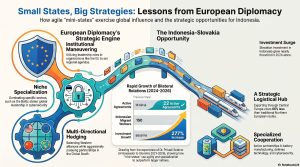
Melihat statistik, tampak hampir tidak dapat dipercaya pada pandangan pertama. Slovakia, negara yang terkurung daratan dengan hanya 5,4 juta penduduk, memperoleh 85,1% output ekonominya dari ekspor. Hongaria tidak jauh tertinggal dengan 88%. Dan Siprus, pulau kecil Mediterania dengan 1,3 juta penduduk, memimpin dengan angka yang menakjubkan yaitu 96,69%.

Untuk setiap dolar aktivitas ekonomi di Siprus, sembilan puluh tujuh sen bergantung pada penjualan sesuatu kepada orang lain. Negara-negara ini tidak hanya berdagang—mereka hidup dan bernapas karenanya. Sebagian besar ekonom akan mengatakan bahwa tingkat ketergantungan ekspor ini merupakan kerentanan. Jika permintaan global melemah, jika jalur pelayaran ditutup, jika mitra dagang menjadi proteksionis—ekonomi ini akan hancur. Tetapi, ini adalah sesuatu yang sama sekali berbeda. Ini bukan kelemahan. Ini adalah strategi yang disengaja.

Bayangkan seperti ini: ketika kita terpojok, kita akan berjuang lebih keras. Negara-negara kecil ini tidak memiliki sumber daya alam untuk diandalkan. Tidak ada pasar domestik yang luas untuk meredam guncangan ekonomi. Tidak ada populasi besar untuk menghasilkan permintaan internal. Mereka harus bersaing atau, mereka akan lenyap. Dan karena itu, mereka membangun seluruh perekonomian mereka di sekitar hal tersebut.


Permainan Spesialisasi

Yang membuat negara-negara ini begitu sukses bukanlah hanya karena mereka mengekspor, tetapi apa yang mereka ekspor, dan bagaimana caranya.

Slovakia diam-diam telah menjadi produsen mobil paling produktif di dunia per kapita. Negara ini memproduksi lebih banyak mobil daripada jumlah penduduknya, menggunakan teknologi canggih yang menempatkannya di garis depan teknik otomotif. Berkendaralah melalui zona industri Bratislava dan Anda akan melihat pabrik Volkswagen, Kia, dan Peugeot yang ramai—masing-masing merupakan bukti dari negara yang mempertaruhkan segalanya untuk menjadi kekuatan manufaktur Eropa.

Hongaria mengambil jalur yang serupa, berfokus pada otomotif, TI, dan pengolahan makanan. Tetapi ada perbedaan penting: Hongaria menawarkan tarif pajak perusahaan terendah di Uni Eropa, hanya 9%. Ketika perusahaan multinasional menghitung di mana akan menempatkan operasi Eropa mereka, angka itu berbicara lebih keras daripada tawaran diplomatik apa pun. Hasilnya adalah banjir investasi asing yang mengubah Hongaria dari negara pasca-komunis yang berjuang menjadi pusat regional.

Republik Ceko memainkan permainan yang lebih panjang. Dengan 10,8 juta penduduk, negara ini memiliki skala untuk mencapai tujuan yang lebih tinggi—dan memang telah melakukannya. Negara ini dengan cepat menjadi pusat industri teknologi tinggi di Eropa: bioteknologi, keamanan siber, dan kecerdasan buatan. Tidak seperti negara-negara tetangganya, Republik Ceko memilih untuk tidak mengadopsi Euro, menjaga independensi kebijakan moneter sambil menikmati semua manfaat keanggotaan Area Schengen. Ini adalah pilihan strategis yang memberikan fleksibilitas kepada negara tersebut sambil mempertahankan integrasi.

Siprus mengambil pendekatan yang sama sekali berbeda. Terletak di persimpangan Eropa, Asia, dan Afrika, pulau ini telah memanfaatkan lokasi strategisnya untuk menjadi gerbang investasi di berbagai sektor: teknologi keuangan, game, pertahanan energi, penelitian dan pengembangan, dan perusahaan rintisan. Yang membuat Siprus sangat menarik adalah tenaga kerjanya—berpendidikan tinggi, berbahasa Inggris, dan bersedia bekerja dengan upah yang kompetitif.

Masing-masing negara ini menemukan ceruknya. Mereka tidak mencoba bersaing dengan Jerman dalam segala hal. Mereka mengidentifikasi area di mana mereka dapat menang, dan mereka mencurahkan segalanya ke sektor-sektor tersebut.


Teka-Teki Integrasi

Mungkin bagian yang paling menarik adalah bagaimana negara-negara ini menavigasi integrasi Eropa. Pandangan umum adalah bahwa integrasi penuh, mengadopsi Euro, bergabung dengan zona bebas perbatasan Schengen, selalu menguntungkan. Tetapi data menunjukkan sesuatu yang lebih bernuansa:


  • Slovakia: Integrasi penuh (Schengen + Zona Euro)
  • Hongaria: Integrasi penuh (Schengen + Zona Euro)
  • Republik Ceko: Integrasi parsial (Schengen, tanpa Euro)
  • Siprus: Integrasi parsial (Zona Euro, tanpa Schengen)


Setiap negara memilih apa yang sesuai dengan keadaan spesifiknya. Tidak ada model yang cocok untuk semua.

Keputusan Republik Ceko untuk mempertahankan mata uangnya sendiri, misalnya, memberinya kendali atas kebijakan moneter yang tidak dinikmati Slovakia dan Hongaria. Ketika Zona Euro menghadapi krisis, bisnis Ceko masih dapat mengandalkan intervensi bank sentral. Sementara itu, Siprus memilih Euro tetapi tetap berada di luar Schengen, mempertahankan kontrol perbatasan yang lebih ketat sambil menikmati stabilitas mata uang yang diberikan oleh keanggotaan tersebut.

Ini bukanlah pilihan acak. Ini adalah keputusan strategis yang diperhitungkan, yang dibuat oleh negara-negara yang memahami persis apa yang mereka korbankan dan apa yang mereka peroleh sebagai imbalannya.


Cermin bagi Indonesia

Beralih ke Indonesia, angka-angka tersebut menceritakan kisah yang sangat berbeda. Ekspor Indonesia hanya mencapai 22,18% dari PDB-nya.

Angka itu dibandingkan dengan rasio 85-96% dari negara-negara kecil Eropa. Indonesia adalah negara dengan 280 juta penduduk, dengan sumber daya alam yang melimpah, basis manufaktur yang berkembang, dan potensi pasar domestik yang besar. Namun, Indonesia mengekspor kurang dari seperempat dari produksi domestiknya.

“Jika negara-negara kecil ini dapat mencapai rasio PDB ekspor 85-96%, mengapa kita tidak bisa?.” Ini membuat kita frustrasi dan rasa ingin tahu yang sama besarnya. Kita memiliki lebih banyak sumber daya. Lebih banyak penduduk. Lebih banyak segalanya.

Jawabannya, terletak pada perbedaan mendasar dalam orientasi ekonomi. Negara-negara kecil Eropa adalah ekonomi industri yang didorong oleh ekspor. Indonesia, terlepas dari ambisinya, sebagian besar tetap didorong oleh konsumsi. Kita memproduksi, tetapi kita mengonsumsi sebagian besar dari apa yang kita buat. Kita memiliki potensi untuk bersaing secara global, tetapi kita belum sepenuhnya melakukannya. Kuncinya adalah industrialisasi. Dan kunci industrialisasi adalah ekspor.


Pergeseran Pragmatis

Era ideologi dalam hubungan internasional telah berakhir. Perang Dingin, dengan aliansi kaku dan blok ideologisnya, telah digantikan oleh sesuatu yang lebih cair dan praktis. Era Perang Dingin di mana ideologi menggerakkan hubungan internasional telah berakhir. Diplomasi saat ini didorong oleh peluang ekonomi.

Pergeseran ini telah menciptakan peluang yang tampaknya mustahil hanya satu generasi yang lalu. Kerja sama pertahanan Slovakia dengan Indonesia, misalnya, tidak didasarkan pada keselarasan politik atau ideologi bersama. Kerja sama ini berakar pada kebutuhan konkret: Slovakia memiliki teknologi militer yang canggih, Indonesia perlu memodernisasi kemampuan pertahanannya; dan kedua negara mendapat manfaat dari pertukaran tersebut.

Logika yang sama berlaku untuk kemitraan keamanan siber, investasi otomotif, dan pertukaran pendidikan. Hubungan ini tidak dibangun atas dasar sentimen—melainkan atas dasar saling menguntungkan.


Keharusan Bertahan Hidup

Kelangsungan hidup suatu negara mengharuskan negara tersebut untuk mencoba setiap pendekatan yang mungkin dilakukan, tidak hanya untuk bertahan hidup tetapi juga menjadi lebih maju. Negara-negara kecil di Eropa ini menunjukkan kepada kita bagaimana hal tersebut dapat dilakukan. Ada sesuatu yang hampir bersifat Darwinian dalam perspektif ini. Di dunia di mana yang kuat semakin kuat dan yang lemah semakin tertinggal, negara-negara kecil di Eropa telah menemukan cara untuk bersaing. Mereka melakukannya melalui spesialisasi, melalui kemitraan strategis, melalui industrialisasi yang agresif, dan melalui fokus yang tiada henti pada pertumbuhan yang didorong oleh ekspor.

Mereka telah membuktikan bahwa kelangsungan hidup bukanlah soal ukuran, tetapi soal strategi.


Pelajaran di Dunia yang Berubah

Bagi Indonesia, dampaknya jelas. Kita dapat terus mengandalkan sumber daya alam dan pasar dalam negeri, dan merasa nyaman dengan status kita sebagai negara “besar”. Atau kita bisa belajar dari negara-negara kecil di Eropa dan menerapkan visi ekonomi yang lebih ambisius.

Data menunjukkan bahwa hal ini bukan hanya sekedar peluang yang terlewatkan, tetapi juga merupakan kesalahpahaman mendasar mengenai cara kerja perekonomian global. Negara-negara kecil di Eropa tidak hanya bertahan; mereka juga berkembang. Dan mereka melakukannya dengan melakukan hal yang selama ini enggan dilakukan oleh Indonesia: bersaing secara agresif di panggung global.

Pertanyaannya bukanlah apakah Indonesia dapat menyamai rasio ekspor mereka. Pertanyaannya adalah apakah kita bersedia mencoba.

Negara-Negara Kecil, Strategi Besar Bagaimana Negara-Negara Mini Eropa Menulis Ulang Aturan Kekuasaan

Oleh Dubes Dr. Pribadi Sutiono

Dalam panggung besar hubungan internasional, kita telah terbiasa mengamati para pemain besar. Ketika pikiran kita beralih ke pengaruh global, secara naluriah pikiran kita tertuju pada koridor kekuasaan Washington, birokrasi Beijing yang luas, atau tembok Kremlin Moskow. Bahkan di dalam Eropa, kita memusatkan pandangan kita pada mesin ekonomi Berlin, kehalusan diplomatik Paris, atau kekuatan finansial London.

Namun, kita telah mencari di tempat yang salah. Drama sebenarnya, menurutnya, sedang berlangsung di antara para pemain yang begitu kecil sehingga hampir tidak terdaftar di peta mental kebanyakan orang.


Pandangan dari Kantor Duta Besar

Siprus pada tahun 2026 adalah sebuah negara yang begitu kecil sehingga bisa muat di wilayah metropolitan Jakarta beberapa kali lipat. Sebuah negara dengan hanya 1,3 juta penduduk, lebih kecil dari banyak kota di Indonesia, memegang jabatan presiden bergilir Dewan Uni Eropa. Namun di sinilah ia berada, menengahi perjanjian, menetapkan agenda, dan membentuk kebijakan yang memengaruhi setengah miliar warga Eropa.

Kecil itu indah. Tetapi dalam hubungan internasional, kecil tidak selalu menjadi batasan. Slovakia, sebuah negara Eropa lain yang jarang menjadi berita utama, berperan jauh di atas kelasnya. Negara ini memproduksi lebih banyak mobil per kapita daripada negara lain manapun di bumi. Kemampuan keamanan siber-nya melegenda. Dan diam-diam telah menjadi salah satu mitra Indonesia yang paling berharga di Eropa, menandatangani satu-satunya perjanjian kerja sama pertahanan di benua itu dengan Jakarta.

Pertanyaannya, bagaimana?


Tiga Jalan Menuju Pengaruh

Seperti kelas master dalam improvisasi strategis, negara-negara kecil Eropa telah mengembangkan tiga strategi bertahan hidup yang berbeda, masing-masing sangat sesuai dengan keadaan unik mereka, dan masing-masing membawa pelajaran yang sebaiknya diserap oleh Indonesia.


Manuver Institusional

Siprus memilih jalan pengaruh institusional. Tanpa kekuatan militer yang berarti dan ekonomi yang dapat ditelan seluruhnya oleh satu perusahaan Jerman, Siprus harus menemukan cara lain untuk menjadi penting. Jawabannya datang melalui Uni Eropa itu sendiri.

Dengan mengamankan kepresidenan Dewan Uni Eropa, Siprus memperoleh sesuatu yang tak ternilai harganya: enam bulan perhatian global. Enam bulan untuk menetapkan agenda. Enam bulan untuk memaksa negara-negara yang lebih besar untuk mendengarkan.

Siprus menggunakan posisi kepresidenan untuk meningkatkan profilnya. Mereka mendorong keras kerja sama pertahanan Eropa dan daya saing ekonomi. Tiba-tiba, semua orang harus memperhatikan pulau kecil ini.

Ini adalah langkah klasik negara kecil: memanfaatkan lembaga-lembaga yang dapat diakses untuk memperkuat suara mereka. Siprus memahami bahwa di Uni Eropa, setidaknya, kesetaraan formal di antara negara-negara anggota lebih dari sekadar fiksi yang sopan—itu adalah realitas yang dapat dieksploitasi.


Strategi Spesialisasi Ceruk

Negara-negara Baltik—Estonia, Latvia, dan Lituania—memilih jalan yang berbeda. Alih-alih mencari keunggulan institusional, mereka membangun keahlian kelas dunia di bidang-bidang yang tidak mudah ditiru oleh negara-negara yang lebih besar.

Kisah ini dimulai pada tahun 2007, ketika infrastruktur digital Estonia mengalami serangan siber besar-besaran, yang secara luas diyakini berasal dari Rusia. Alih-alih hanya memperbaiki kerusakan dan melanjutkan, Estonia membuat pilihan strategis. Mereka akan menjadi sangat ahli dalam keamanan siber sehingga tidak ada yang dapat mengabaikan mereka.

Ketiga negara ini telah mempertajam spesialisasi mereka ke satu bidang. Mereka menciptakan kedutaan data, mereka menjadi pusat saraf keamanan siber Eropa. Ketika perang Ukraina dimulai, merekalah yang memimpin pertahanan siber Eropa.

Latvia menjadi tuan rumah Pusat Keunggulan Komunikasi Strategis NATO. Infrastruktur digital Estonia kini dianggap sebagai salah satu yang paling aman di planet ini. Lithuania telah menjadi pusat kerja sama keamanan regional.

Kehebatan pendekatan ini terletak pada keberlanjutannya. Anda tidak membutuhkan tentara yang besar atau ekonomi yang luas untuk menjadi yang terbaik di satu bidang yang sangat khusus. Anda hanya perlu cerdas, fokus, dan gigih.


Hedging Multi-Arah

Slovakia mewakili sesuatu yang lebih kompleks, tindakan penyeimbang yang memerlukan ketangkasan diplomasi yang luar biasa. Negara ini berada di pusat geografis Eropa, sebuah posisi yang secara historis berarti terjebak di antara kekuatan-kekuatan yang saling bersaing. Daripada memihak, Slovakia justru menganut apa yang disebut Duta Besar Pribadi sebagai strategi “Empat Sudut Kompas”.

Slowakia tidak ingin lagi disebut Eropa Timur. Mereka bersikeras pada Eropa Tengah. Dan itu bukan sekadar kesia-siaan dan ini adalah pernyataan strategis.

Negara ini memelihara hubungan yang kuat dengan lembaga-lembaga Barat seperti NATO dan UE sekaligus membina hubungan dengan negara-negara Selatan, khususnya di Asia Tenggara. Ketika Menteri Luar Negeri Slovakia mengunjungi Kamar Dagang Indonesia baru-baru ini, beliau datang dengan membawa peluang: insentif investasi, keuntungan logistik, dan sambutan hangat yang mengejutkan bagi dunia usaha di Indonesia. Mereka melihat ke luar Eropa,” jelas Dubes Pribadi. Dan itu menciptakan ruang bagi mereka.

Hasilnya? Slovakia telah menjadi pintu gerbang Indonesia menuju benua tersebut. Hubungan bilateral tersebut telah menghasilkan 22 perjanjian aktif sejak tahun 2022, investasi Slovakia di Indonesia melonjak 277% pada tahun 2024, dan pekerja migran Indonesia di Slovakia meningkat dari hanya 150 menjadi 1.650 selama masa jabatan Dubes Pribadi.


Teori di balik Praktik

Kita perlu membalikkan pendekatan akademis yang standar. Daripada memulai dengan teori dan kemudian mencari contoh, kita perlu mengamati contoh-contoh tersebut terlebih dahulu dan kemudian bertanya: kerangka teori apa yang menjelaskan apa yang kita lihat?

Jawabannya adalah “realisme neoklasik”—sebuah istilah bagus untuk sebuah gagasan sederhana: tekanan sistemik disaring melalui politik dalam negeri. Secara sederhana, tantangan global menciptakan peluang, namun hanya jika kepemimpinan, lembaga, dan kepentingan nasional suatu negara selaras untuk meraih peluang tersebut.

Pertimbangkan Eropa sekarang. Benua ini terhuyung-huyung akibat krisis yang saling tumpang tindih: perang Ukraina, kekurangan energi, inflasi, dan meningkatnya ketegangan antara AS dan sekutu-sekutunya di Eropa. Tekanan-tekanan ini menghasilkan gelombang nasionalisme dan populisme di seluruh kawasan. Tekanan sistemik di Eropa sangat besar. Dan ini memaksa negara-negara kecil untuk beradaptasi dengan cara yang benar-benar menguntungkan kita.

Pergeseran Slovakia ke arah Dunia Selatan, misalnya, bukan hanya soal ideologi, tetapi soal kelangsungan hidup. Ketika Eropa berada dalam kekacauan, diversifikasi hubungan menjadi masalah keamanan nasional. Dan bagi Indonesia, hal ini menciptakan sebuah pembukaan yang luar biasa.


Peluang Indonesia

Pengusaha Indonesia perlu untuk menjajaki peluang di Slovakia. Namun rekomendasi ini hanya mendapat tatapan kosong. Kadang-kadang pengusaha kita hanya mengenal Belanda, Jerman, Paris, London. Ini menimbulkan frustrasi. Saat di=berityahu tentang Slovakia, para pengusaha justru bertanya, “Mengapa pergi ke sana? Apa gunanya?’”

Jawabannya terletak pada aritmatika dasar. Slovakia berada di pusat Eropa. Mendirikan pusat logistik di sana berarti akses ke seluruh pasar Eropa dengan biaya yang jauh lebih rendah. Biaya ekspor melalui Eropa Selatan hanya sepertiga dari biaya ekspor melalui Eropa Utara—sebuah perbedaan yang sangat penting ketika margin tipis.

Ada alasan Slovakia tidak mau lagi disebut Eropa Timur. Mereka telah berkembang pesat, dan mereka menawarkan syarat-syarat yang lebih menguntungkan dibandingkan negara-negara tradisional. Peluangnya bukan hanya ekonomi. Industri maju di Slovakia, manufaktur otomotif, keamanan siber, teknologi pertahanan, bioteknologi, menawarkan jalur bagi perusahaan dan institusi Indonesia menuju pengetahuan dan kemitraan mutakhir.

Hasilnya sudah bisa dilihat. Kolaborasi pabrik baterai, perjanjian kerja sama pertahanan, kemitraan keamanan siber dengan BSSN. Ini bukan sekadar selembar kertas. Mereka adalah kemitraan hidup yang menguntungkan kedua belah pihak.


Pelajaran yang Terlupakan

Kita masih berpegang pada peta mental yang sudah ketinggalan jaman. Para pembuat kebijakan, pemimpin bisnis, dan bahkan akademisi di Indonesia sering kali mempunyai pandangan yang sangat terbatas terhadap Eropa. Kita memiliki kecenderungan untuk memperlakukan Eropa Timur sebagai sebuah monolit. Atau, lebih buruk lagi, kita bahkan tidak tahu di mana negara-negara ini berada. Namun negara-negara ini telah mengubah diri mereka sendiri, dan mereka menghubungi kita.

Indonesia sedang mengalami rasa berpuas diri yang berbahaya. Indonesia melihat dirinya sebagai sebuah negara besar, dan bertindak sesuai dengan pandnagan tersebut, mengandalkan ukuran dan sumber daya alam kami untuk menarik perhatian. Namun di dunia sekarang ini, pengaruh mengalir ke kelompok yang gesit, bukan hanya kelompok yang jumlahnya banyak.


Cara Melihat yang Baru

Berdasarkan dua puluh lima tahun pengalaman  dalam diplomasi, yang dibutuhkan saat ini adalah pragmatisme geopolitik. Dari Siprus hingga Slovakia, negara-negara kecil telah membuktikan bahwa pengaruh dibangun melalui pragmatisme, spesialisasi, dan jaringan—bukan sekadar kapasitas material.

Ini adalah pelajaran yang melampaui batas-batas Eropa. Di dunia di mana kekuasaan semakin menyebar, hierarki tradisional mulai runtuh, dan para raksasa semakin sulit mengendalikan permainan, para pemain kecil menunjukkan kepada semua orang bagaimana hal itu dilakukan. Bagi Indonesia, sebuah negara yang sering digambarkan sebagai negara yang “besar tapi belum besar”, implikasinya jelas: jika kita ingin menjadi berarti, kita perlu berpikir seperti negara-negara kecil. Kita perlu bersikap strategis, fokus, dan bersedia menjajaki kemitraan yang tidak konvensional.

Kita harus berhenti bertanya “Mengapa di sana?” dan mulai bertanya “Mengapa tidak?”

EU – LATIN AMERICA & CARIBBEAN STEPPING UP RELATIONS
Source: EU and Latin America and the Caribbean stand together.

Hendra Manurung1 and Sebastián Sterzer2

1Hendra Manurung is currently a doctoral candidate in International Relations at Padjadjaran University

2Sebastián Sterzer is Head of International Relations Department at the Observatory of International Trade of National University of Lujan, Buenos Aires, Argentina

In December 2020, the European Union and Latin America and the Caribbean (LAC) aim to reaffirm and give new impetus to the strategic partnership through an informal meeting of EU27 and the LAC Foreign Ministers in Berlin, Germany. This is an opportunity to reinforce the close cultural, social and economic bonds, as well as to coordinate our approach in a less predictable international system. 2020, has been particularly difficult for both EU and Latin American and Caribbean regions due to the COVID-19 pandemic and the economic recession it has brought about. However, during 2021, it is time to start thinking again about stepping up relations. The EU is helping people make Latin American and Caribbean ideas become reality. Faced with growing geopolitical rivalry between great powers, it offers cooperation and dialogue centered on improving the lives of citizens. This relationship is a clue to sustaining the multilateral system in matters such as WTO, the Paris Agreement, human rights, arms control and non-proliferation. While, in the international system, economic diplomacy pertains to the full spectrum of diplomacy relating to economic activities in the pursuit of a country’s policy objectives in general and economic goals in particular. Previously, the economic diplomacy follows a policy direction laid down by Indonesian President Joko Widodo, whereby 70 to 80 percent of all resources should be dedicated to more effective and efficient efforts on economic diplomacy, amid a world full of uncertainty and the upsurge of protectionisms posing challenges to many countries.

Further, as the world strives to deliver joint responses to common challenges, from crushing pandemics to tackling climate change, organizations that encourage research cooperation between regional partners are needed more than ever and united in a common cause. This bond was reaffirmed by EURAXESS Latin America and the Caribbean (LAC), which took part in a recent high-level meeting in 2020 of the EU-CELAC Joint Initiative. It served as a valuable reminder of the common bonds that tie research organizations and communities in all regions together and reinforced the importance of researcher mobility and knowledge-sharing in tackling the biggest challenges facing the world.

The Latin American and Caribbean countries are also still faced with new dynamics challenge, such as the need to respond to the demands of a digital and integrated global economy, the pressure to safeguard the environment, adapting to climate change issue, and to promote growth while ensuring fair social outcomes, or the concern to ensure the continuation of a long-term trend of democratic consolidation and sustainable development.

The EU, with its model of regional economic integration and connectivity, can be an important partner of LAC in tackling those challenges. The EU is sharing its full diplomatic, humanitarian and economic support to solving the ongoing crises in certain LAC countries and will continue to promote democratic principles and respect for human rights in its relations with LAC. More broadly, the EU and LAC should work together to preserve multilateralism and a rules based global order, joining forces to deliver ambitious agendas. This strategic partnership should concentrate on four mutually reinforcing priorities: 1) prosperity, 2) democracy, 3) resilience and 4) effective global governance. Under each of these priorities the communication suggests a number of areas and concrete initiatives to advance this agenda, implemented through a more strategic and targeted EU engagement with the region.

Historically, over the last decades, the EU and LAC have reached an unprecedented level of integration. The EU has signed association, free trade or political and cooperation agreements with 27 (twenty seven) of the 33 (thirty three) LAC countries. This all LAC countries included except Argentina, Bolivia, Brazil, Paraguay, Uruguay and Venezuela. The most important of these are the Association Agreements with Mexico, Chile and Central America, the Economic Partnership Agreement with the Caribbean Forum (CARIFORUM) and the Free Trade Agreements with Colombia, Peru and Ecuador. The EU and LAC countries often align in the United Nations, and have closely cooperated on the Paris agreement, and the 2030 Agenda for Sustainable Development. Since 2016, there is close to six million people from EU and LAC live and work across the Atlantic, and more than one third of LAC students studying abroad do so in the EU countries.

Post 2016, in the wider Atlantic Space, the EU has expanded cooperation and builds stronger partnerships with Latin America and the Caribbean grounded on shared values and interests. It is emphasized clearly at ‘A Global Strategy for the European Union’s Foreign and Security Policy’. The EU and Latin America and the Caribbean have a successful and long-standing partnership which united by history and guided by many shared values. Therefore since 1999 EU and LAC are linked by a strategic partnership and grounded on a commitment to fundamental freedoms, sustainable development and a strong rules-based international system. For over twenty years, such a partnership has been a platform for mutually beneficial cooperation, a driver of change and an incubator for new ideas.

Obviously, the economies are closely interconnected. EU is the third largest trade partner of LAC; total trade in goods increased from €185.5 billion in 2008 to €225.4 billion in 2018, and trade in services amounted to almost €102 billion in 2017. The EU is the first investor in LAC, with a foreign direct investment (FDI) stock of €784.6 billion in 2017, whilst the LAC FDI stock in the EU increased substantially over recent years reached to €273 billion in 2017. The EU investment in LAC is significantly higher than the EU FDI stocks in China is €176.1 billion, except Hong Kong; India with €76.7 billion; and Russia with €216.1 billion combined.

Also, the EU has been the largest provider of development cooperation to LAC, with €3.6 billion in grants for bilateral and regional programs between 2014 and 2020, and over €1.2 billion in humanitarian assistance to victims of man-made crises and natural disasters the last 20 years (1996-2016). The European Investment Bank invests in the achievement of the Sustainable Development Goals in LAC, with a focus on climate change mitigation and adaptation, lending a total of €3.4 billion during 2014-2018. Furthermore, the EU’s development cooperation to LAC also focuses on critical areas such as security and the rule of law, environmental sustainability and climate change, agriculture, food and nutrition security, inclusive economic growth for employment creation, public financial management reform, public sector modernization, and regional integration.

Contextually, this communication proposes to strengthen the EU’s political partnership with LAC, setting out a vision for a stronger and modernized bi-regional partnership, in light of changing global and regional realities. This communication should also be read in light of the agreements that exist or are being negotiated between the EU and individual LAC countries or sub-regions; covering virtually the entire region they represent an important vehicle to implement the vision set out here within. It aims to provide strategic direction for EU’s external action with LAC, in line with the principles set out in the Global Strategy for the EU’s Foreign and Security Policy, the European Consensus on Development, the 2030 Agenda for Sustainable Development, the “Trade for All” Communication and the negotiating directives for a partnership agreement between the EU and the African, Caribbean and Pacific Group of States.

Since 2012, the EU has a long and rich experience on promoting cross-border cooperation. The development of territorial cooperation actions, in particular cross-border cooperation, is considered a fundamental factor for the development of regional integration processes, of economic and social cohesion, and of progress. This EU’s cross-border cooperation program is previously being implemented through agreed cross-border analysis and response strategies, formulated in each of the 53 cross-border program. It deals with a wide range of issues, which include: encouraging entrepreneurship, especially the development of SMEs, tourism, culture and cross-border trade; improving joint management of natural resources; supporting links between urban and rural areas; improving access to transport and communication networks; developing joint use of infrastructure; administrative, employment and equal opportunities work.

The overall aim of disseminating the experience of the EU’s regional policy and its best practices in 2015, both in terms of innovation and cross-border cooperation, the “EU-Latin America Cooperation on Cross-Border Regional Innovation Systems in the framework of Regional Policy” project has promoted cooperation between authorities in the border regions of Peru and Brazil, and has identified the innovative sectors key to cooperation between the regions participating in the project. Selected were the regions of Loreto and San Martin, in Peru, and the State of Amazonas, in Brazil, which borders on the Peruvian region of Loreto. As a result of the work aquaculture was considered a field of economic activity boasting great potential and a basis upon which to bolster cross-border cooperation through the creation of an interregional aquaculture value chain. Based on the lessons learned through European countries experiences, and the results of collaboration with local stakeholders, a strategic approach was devised to guide actions at the regional level, making it possible to coordinate and align the different actors in the border area in light of the needs and opportunities posed by the aquaculture value chain as regards Cross-Border Cooperation, and the development of regions, their companies and peoples. It continues with a description of the research and development structure of the participating regions, more consolidated on the Brazilian side, but featuring a very great potential for cooperation.

These Latin America and Caribbean regions also should share the need to fortify the qualifications of the social capital engaged in the aquaculture sector. There is a high rate of informality, which has a considerable impact, giving rise to market failures. The main problems include a weak corporate culture, poor transport and telecommunications infrastructures, and an inefficient energy system as a key resource affecting the costs and production capacities of the other economic activities. Worthy of special note is the lack of an established system to support research and development activities, oriented towards the needs of the business sector, and the limited technological development, which would make it possible to respond to the challenges posed by other areas, such as transport, logistics and energy.

In Latin American countries, border regions and municipalities are increasingly demanding instruments for cross-border cooperation, being a growing field under permanent development. Previously, in May 2008, the European Union and Latin America Summit took place in Lima, Peru, at which, Venezuelan President Hugo Chavez made a number of provocative statements. Countries in the Latin American region appear with the interests of each country, which are competitive and not yet fully synergized. In fact, it is a condition that does not facilitate economic and trade negotiations which took place at the summit.

Both regions must be able to accelerate economic development in the emerging potential economies by driving skillful job through large-scale initiatives in entrepreneurship, small business growth, innovation, and skilling.  In the years ahead, it is expected that the necessary steps to improve the business and investment environment in the intra and extra region should be taken committedly by all stakeholders. The opportunities the agreements provide which is more effective government procurement, better market access, innovation and competitiveness, intra-regional trade and integration into global supply chains should be exploited. Effective and balanced protection of Intellectual Property Rights enhances opportunities for mutual research cooperation and stimulates regional competitiveness and creative innovation. At the same time, trade agreements should further sustainable development, human rights and good governance, which the EU should work together sustainably with LAC to strengthen the implementation of social, labor and environmental provisions in existing agreements, consistent with their shared commitment to the 2030 Agenda for Sustainable Development, and promote responsible management of global supply chains.

During and post global pandemic, The EU should continue partnering with Latin American and Caribbean countries in generating efforts to address persisting macroeconomic challenges in the region, while diversifying and modernizing the different economic models, making them fit for globalization. Suppose, making results sustainable also means to joining forces to reduce socio-economic inequalities, creating decent jobs and making globalization work for all, and the transition towards a green and circular economy development.

INDONESIA-EFTA CEPA 2021: IMPLEMENTATION IN TRADE & INVESTEMENT
EFTA Secretary-General meets Indonesian Deputy Minister of Trade in Geneva to discuss on EFTA–Indonesia Comprehensive Economic Partnership Agreement on April 30, 2021(CEPA)

Writer: Hendra Manurung is currently a doctoral candidate in International Relations at Padjadjaran University, Bandung, West Java

Switzerland, Liechtenstein, Norway and Iceland as EFTA countries are ideal partner due to their high purchasing power markets as well as having the value of large foreign investment to most developing countries. It can be used as an entry point for Indonesia’s trade advantages in goods, services and investment in continental Europe, and the potential export destination with products complementary. The IE-CEPA Agreement benefits for Indonesia are enormous due to Indonesia’s market access expansion to EFTA countries and accelerating the competitiveness quality of Indonesian products. The cooperation between the five countries, involving Indonesia, Switzerland, Iceland, Norway, and Liechtenstein will not harm each other. In fact, there are many benefits that can be obtained, particularly with the zero-tariff policy which is applied to almost 99 percent of Indonesian products exports to EFTA countries.

Indonesia is currently offering EFTA countries commitments in 5 (five) potential investment sectors, namely: 1) agriculture, 2) mining, 3) manufacturing, 4) energy, 5) clean water supply. Indonesia and the European Free Trade Association Comprehensive Economic Partnership Agreement, known as IE-CEPA are targeted to be rolled out in semester II-2021. Indonesian Ministry of Trade and the Chamber of Commerce and Industry of Indonesia continue to finalize the implementation of investment and trade in the four countries that are members of the European Free Trade Association or EFTA.

The four countries are Switzerland, Norway, Iceland and Liechtenstein. In the trade sector, Indonesia will get a 0 percent tariff on the elimination of 7,042 tariff posts or 81.74 percent of the total tariff posts from Switzerland and Liechtenstein, 8,100 tariff posts (94.28 percent) from Iceland, and 6,388 tariff posts (99.94 percent ) from Norway. Through the IE-CEPA cooperation forum, it is likely that Indonesia’s industrial and business sectors can generate exports and gain foreign investment from Europe to support the acceleration of national economic growth. Previously, on March 22, 2021, the Indonesian government and the People’s Representative Council of the Republic of Indonesia officially passed the Draft Law on the Comprehensive Economic Partnership Agreement between the Republic of Indonesia and the EFTA States aka the Comprehensive Economic Partnership Agreement between the Republic of Indonesia and EFTA Countries). In the trade sector, Indonesia can take advantage of a 0 percent rate to boost exports of competitive products to the four EFTA countries.

The Swiss government imposes tariffs of 0 percent for a wide range of gold products and jewellery, textiles, footwear, two-wheeled vehicles, and essential oils. While the government of Iceland, has imposed a tariff of 0 percent for the products of Indonesian export commodities, such as coffee products, footwear, fish oil, fish, shrimp, paper, and furniture.

Moreover, in the investment sector, the Indonesian government has offered commitments in 5 (five) potential investment sectors consisting of 182 sub-sectors. The five strategic sectors include agriculture, mining, manufacturing, energy, and the provision of clean water. Until now, Indonesia has ratified IE-CEPA through Law Number 1 of 2021 concerning the Ratification of IE-CEPA. Currently, Indonesia only has to complete 2 (two) derivative regulations, namely a) regulations of the minister of trade and b) regulations of the minister of finance.

Indonesia-European Free Trade Association Comprehensive Economic Partnership Agreement or Indonesia-EFTA CEPA or IE-CEPA is economic cooperation between Indonesia and the EFTA group of countries consisting of Iceland, Liechtenstein, Norway, and Switzerland. Indonesia’s agreement with an EFTA country is Indonesia’s first comprehensive economic agreement with a country in Europe. In addition to increasing exports, investment and market access to the European continent, IE-CEPA is expected to raise the profile and positive campaign for Indonesian palm oil products globally and encourage the acceptance of sustainability standards for Indonesian palm oil (ISPO) by Switzerland.

In the future after the enactment of the National Bill on IE-CEPA, the government will make supporting regulations to implement IE-CEPA in the form of a Minister of Finance Regulation regarding the procedures for imposition and determination of import duty rates, as well as a Regulation of the Minister of Trade regarding the provisions of a certificate of origin. This comprehensive agreement consists of 12 chapters, 17 attachments, and 17 additional documents from the appendix covering issues of trade in goods and services, investment, protection of intellectual property rights, procurement of government goods and services, and cooperation and capacity building. The IE-CEPA Agreement is Indonesia’s first trade agreement with countries on the European continent. In addition, the Government of Indonesia should immediately prepare strategic steps through coordination efforts with relevant ministries and agencies, as well as stakeholders to implement IE-CEPA which is targeted at the beginning of the second quarter of 2021.

Henceforward, with the passage of the draft law into National Law, the Indonesian Parliament has carried out the constitutional mandate because IE-CEPA and the Omnibus Law is expected able to promote economic transformation and improve public welfare, particularly in promoting post-Covid-19 national economic recovery. IE-CEPA is the initiation of negotiations between Indonesia and EFTA countries starting in 2005 through the establishment of a joint feasibility study, which was followed by negotiations since 2011. Negotiations were suspended in 2014 and reactivated in 2016. The IE-CEPA was signed on 16 December 2018 in Indonesia by the Indonesian Minister of Trade and Ministers representing EFTA countries. This agreement also covers issues of trade in goods and services, investment, protection of intellectual property rights, procurement of government goods and services, and cooperation and national capacity building.

In 2018, the IE-CEPA negotiations have been going on intensively for 8 years since 2010, where the longest CEPA negotiations have ever had by Indonesia to date. Indonesian business actors should seriously optimize the CEPA with the EFTA countries that have been struggling for a long time because based on a survey some of the free trade agreements have stalled or are not being properly utilized. The IE-CEPA negotiations lasted for eight years before finally being declared substantively concluded by negotiators at a meeting in Bali on 29 October to 1 November 2018, and declared final by the Ministers on 23 November 2018 in Geneva, Switzerland. Previously, Indonesia had signed a CEPA with Chile in December 2017 in Santiago. In fact, in 2019 most international events also covers dangerous clashes between major powers in the Middle East and in South Asia. Missile strikes, proxy attacks and challenges to freedom of navigation in the Persian Gulf in mid-2019 raised the possibility of Iran going to war with Saudi Arabia and other regional powers, and potentially with the United States. While India and Pakistan as neighbouring countries also disputed over Kashmir and escalated to open conflict. In Asia-Pacific, these two countries are nuclear-armed states. Henceforth, in both cases, the situation eventually calmed, but not as a result of traditional crisis management. Therefore, in 2019 there were no gains and some further setbacks in nuclear arms control. The USA withdrew from the 1987 Treaty on the Elimination of Intermediate-Range and Shorter-Range Missiles (INF Treaty) and Russia formally suspended its obligations under it. Uncertainty continued about whether the Moscow and Washington bilateral 2010 Treaty on Measures for the Further Reduction and Limitation of Strategic Offensive Arms (New START) would be extended beyond its current expiry date of February 2021. Additionally, discussions on denuclearization between the Democratic People’s Republic of Korea (North Korea) and the USA lost traction during 2019 and by the end of the year, the Iran nuclear deal (2015 Joint Comprehensive Plan of Action) was largely non-functional. Amid the threat of sanctions by European countries to Belarus in the midst of 2021, the arrest of Roman Protasevich, one of the Belarussian dissidents who have been a constant thorn in Lukashenko’s side. Protasevich was pulled off the plane, along with several other Belarusian and Russian nationals. Vilnius has become a hub of opposition to Lukashenko’s rule, with Lithuania rejecting Lukashenko’s legitimacy and providing support and protection to exiles. However, sooner or later, it turns Belarus will become Europe’s North Korea issue.

Switzerland has gained the support of the Senate on December 20, 2019, and followed by a public referendum on March 7, 2021, to implement the IE-CEPA. In IE-CEPA negotiations, Switzerland agreed to accept the certification of sustainable palm Indonesia, the Indonesia Sustainable Palm Oil (ISPO). As for Norway and Iceland has completed their ratification on December 13, 2019, and January 29 2020. Liechtenstein is still in the process of ratification.

Indonesia has full confidence through the implementation of the IE-CEPA implementation in the Comprehensive Economic Partnership Agreement. In the future, it will bring Indonesia’s economy to be stronger, more competitive, and attractive to investors from EFTA’s developed countries. The government needs to take strategic policies to face global challenges which are currently full of uncertainty and promote economic recovery after the Covid-19 pandemic. One is through the Agreement’s IE-CEPA.

INDONESIA-FRANCE RELATIONS: STRATEGIC OPPORTUNITIES IN THE INDO-PACIFIC
Source: Ambassade d’Indonésie en France (2020)

Writer: Hendra Manurung is currently a doctoral candidate in international relations at Padjadjaran University, Bandung

In an international context marked by uncertainty and the increase in unilateralism, France’s priority is to propose an alternative: a stable, multipolar order based on the rule of law and free movement, and fair and efficient multilateralism. The Indo-Pacific region is at the heart of this strategy. This strategic region has major global importance in terms of biodiversity and climate change, particularly considering the demographic and economic weight of the area as well as the energy intensity of its natural resources. For France, the Indo-Pacific space is a geographic reality. France is present in the region via its overseas territories, and 93% of its exclusive economic zone is located in the Indian and Pacific Oceans. The region is home to 1.5 million French people, as well as 8,000 soldiers stationed in the region.

France is likely to intensify our mobilization in regional organizations, starting with ASEAN, which aims to remain at the heart of the construction of a multipolar Asia, and of which we are now a development partner, as well as in the Indian Ocean Rim Association, the Indian Ocean Community, the Pacific Community, and the Pacific Islands Forum. Henceforward, France’s strategy for the Indo-Pacific has become one of its priorities for international action since launched by the President of the French Republic during his Garden Island speech in Sydney, Australia in May 2018. In 2021, three years later, the strategy’s implementation is now producing tangible results and major progress in France’s commitments in the region. Paris wants to be more involved in the resolution of regional crises, in the securing of the main shipping routes and in counter-terrorism efforts, including terrorist financing, radicalization and organized crime. Further, it wants to strengthen the ties that bind the countries of the region on the basis of converging visions and shared interests, including with Indonesia, Australia, India, Japan, Malaysia, New Zealand, Singapore, South Korea and Vietnam, while deepening its relations with China, in the strategic framework that is now that of Europeans concern.

The Indo-Pacific has also become France’s strategic geopolitical and geo-economic reality. The global economy’s centre of gravity has shifted from the Atlantic to the Pacific. Six members of the G20, such as Australia, China, India, Indonesia, Japan and South Korea are located in the region. The maritime trade routes linking Europe and the Persian Gulf to the Pacific Ocean, via the Indian Ocean and South-East Asia, have become very important. The region’s growing share of world trade and foreign investment means that it is at the forefront of globalization and tremendous digital technology advance.

The enhancement of bilateral relations between Indonesia and France is pursued in order to achieve the mutual benefit interests and welfare of the people of the two countries, as well as to strengthen relations in various fields, particularly defence, trade, investment, tourism, culture, industry, economy, digital technology, as well as international cooperation.

Indonesia and France bilateral relations have been going on for 70 (seventy) years and have been well established since September 1950, and now both countries continue to improve as identified from the cooperation in various sectors. This cooperation is also evident from a number of dialogue activities and visits between officials of the two countries, both in a bilateral and multilateral framework, as well as mutual support in various nominations/candidacies in international organizations. Since 2011, right on the 60th anniversary of diplomatic relations between Indonesia and France, the two countries have agreed to forge a strategic partnership. Lion Air bought 234 Airbus aircraft in 2013. Although Airbus is a European program, the planes are made in Toulouse and France is recognized for its technologies and its innovative abilities. Last September 2014, Telkomsel chose Thales Technologies and Arianespace to launch its Telkom 3S satellite by 2016. The two countries agreed to establish a Strategic Partnership during the official visit of Prime Minister François Fillon to Indonesia from 30 June to 2 July, which focused on five areas of cooperation, namely: 1) Trade and investment, 2) education, 3) industry defence, 4) socio-cultural / people-to-people contacts, and 5) handling the impacts of climate change.

Henceforth, as one of the strategic economic cooperation partners, the government always maintains and improves bilateral relations with France that have existed for 70 years (1950-2020). In the midst of the global crisis due to the Covid-19 pandemic, maintaining close relations between one country and another need to be maintained sustainably, likewise the emphasis on the relationship between the government and the business world in one country with other countries is also becoming more important. Indonesia and France need to strengthen economic cooperation to face the challenges caused by the Covid-19 pandemic. Among other things, by always maintaining dialogue, including maintaining the flow of goods, especially food, medicine and medical equipment. In June 2020, Indonesia appreciates the assistance to develop health infrastructure in the Covid-19 pandemic that occurred due to the collaboration between Agence Française de Development (AFD) and PT Sarana Multi Infrastruktur (SMI).

This strategic partnership cooperation continues to be well established, until in March 2017, President François Hollande visited Jakarta and held a bilateral meeting with President Joko Widodo. The two leaders agreed to continue to strengthen bilateral cooperation between Indonesia and France, particularly in the fields of the creative economy, education, maritime affairs, sustainable cities development, energy, defence, and infrastructure. Shortly thereafter, President Joko Widodo also met President Emmanuel Macron, who officially became President of France on 14 May 2017, at the G20 Summit meeting in July 2018 in the City of Hamburg, Germany.

Indonesian government has always been committed to prioritizing public health and reviving the economy, prioritizing cooperation with various parties, implementing good government governance and reducing inefficient bureaucracy, and eliminating overlapping regulatory rules.

French entrepreneurs investments have entered into several lines of business in Indonesia. Especially since the visit of the French President to Indonesia on March 29 2017, there have been a number of bilateral agreements in the maritime and fisheries sector, creative economy and sustainable urban development. In addition, France which is well-known for the Eiffel Tower is one of Indonesia’s main export markets in Europe. Indonesian main commodities consist of palm oil, electrical machinery and equipment, rubber, footwear, furniture, and so on. France is also an important partner in development and environmental cooperation. In the first quarter of 2020, the investment disbursed by France to Indonesia was US$ 754 million, an increase from US$ 702 million in the same period in 2019.

Meanwhile, in terms of investment, Indonesian Investment Coordinating Board noted that the realization of French investment in Indonesia reached US$ 16.89 million for 255 projects (2019). This is a significant increase compared to the same period in 2018 which was valued at US$ 13.10 million for 186 projects. At present, Indonesia’s national development is related to the development of the implementation of Indonesian policies in the face of the Covid-19 pandemic, including the Exit Strategy, the National Economic Recovery Program and the Omnibus Law.

In the field of education, the French government together with Indonesia formed a joint working group cooperation forum, which includes, among other things: the double degree program at Masters and the Joint Supervision program at Doctoral Strata which is co-financed. The number of Indonesian students in France is 425 people, which is the highest in the last five years, from 2011 to 2016. Meanwhile, vocational secondary education cooperation has been established through a number of apprenticeship/internship programs in France attended by several vocational school teachers.

The defense cooperation between Indonesia and France is strengthened recently due to the two countries awareness in independence of managing the defense sector, including military tools and personnel maintenance.

Thereafter, as strategic partners, the relations between the two countries have been going well and open up great opportunities to increase defense cooperation. Indonesia needs to strengthen cooperation with France in an effort to strengthen and modernize the main tools of the defense system and advance the national defense industry. It is expected that the mutual cooperation will be established and benefit mutually in accelerating the progress of the defense industry in Indonesia as well as strengthening the Indonesia military defense system through technology transfer, increasing the use of local content and also increasing human resource capacity, as well as French collaboration to make Indonesia a key part of global production in defense equipment products. In the field of defense cooperation, bilateral cooperation between the two countries is based on the 1996 Memorandum of Understanding between Indonesian Ministry of Defense and the French Ministry of Defense in the fields of: cooperation in military equipment, logistics and defense industries. This cooperation was further enhanced through the holding of Military Bilateral Talks between the Indonesia military forces (TNI) Headquarters and the French, namely the AP French Headquarters, namely for the fields of education, information exchange, and dialogue forums.

Meanwhile, for socio-culture, there were a number of Franco-Indonesian associations in France that were particularly active in the arts and culture sector. These associations also contribute to improving good relations, especially people-to-people-contact, between French and Indonesians. On the other hand, there are also a number of universities in France that have Indonesian language programs, which are an asset in introducing Indonesian culture in France. In France every year there are a number of cultural and tourism promotion activities carried out by Indonesia and the local government of France.

During the visit of French President Francois Hollande to Jakarta in March 2017, Indonesia and France signed 5 (five) memoranda of understanding, namely: in the field of urban development sustainability, tourism, defense, science and research, and the exchange of research personnel. Furthermore, with regard to maritime cooperation, Jakarta has requested Paris cooperation in fighting IUU fishing, including making Illegal, unreported and unregulated (IUU) fishing into transnational organized crime.

Meanwhile for the creative economy sector, cooperation in the fields of cinematography, film, fashion and the digital economy will continue to be developed. Further, in the tourism sector, France sees Indonesia as a very large archipelagic country so that transportation needs to be developed and will also increase the number of tourist visits.

Indonesia and France also have a very strong cooperation closely on various international issues, including the issue of Palestinian independence, world peace forces, and against extremism and terrorism. The two countries agreed to fight for this achieving Palestinian-Israeli peace through the concept of two state solutions. Indonesia and France as contributors to the peacekeeping force world under the United Nations, agreed to increase cooperation, including increasing the capacity of the French language for Indonesian peacekeeping forces. The existence of a peacekeeping force is a commitment between France and Indonesia to jointly eliminate conflicts in the world. The spread of tolerance values and eliminate xenophobia as a joint effort to eradicate extremism and global terrorism.

France perceives Indonesia with 270 million inhabitants, which has citizens of the world’s largest Muslim majority country, capable of presenting a tolerant and plural diversity. This is an inspiration for France, namely upholding the principles of freedom and tolerance to eliminate terrorism without discrimination.

It is expected that France together with Indonesia will be able to cooperate more and make new breakthroughs towards significant partnerships in the fields of defense, economy, politics, security, as well as socio-culture. Both countries cooperation supposes are not only beneficial for bilateral interests in short and medium-term, but also regional and international interests, including through mutual support in international forums continuously.

EU SANCTION ON MYANMAR: HUMAN RIGHTS VIOLATIONS
EU sanctions in Myanmar, 22/03/2021

Writer: Hendra Manurung is currently a doctoral candidate in international relations at Padjadjaran University, Bandung

On March 22, 2021, the European Union has imposed sanctions on 11 top Myanmar military officials, including General Min Aung Hlaing who led the coup on February 1, 2021. The sanctions for Min Aung Hlaing are in the form of asset freezing, visa blacklisting and travel ban.  Additionally, EU citizens and companies are forbidden from making funds available to the listed individuals and entities. Further, ten of the eleven persons targeted belong to the highest ranks of the Myanmar Armed Forces, known as Tatmadaw, including the Tatmadaw’s Commander-in-Chief, Min Aung Hlaing, and Deputy-Commander-in-Chief, Soe Win. The other is the new Chairperson of the Union Election Commission for his role in cancelling the results of the 2020 elections in Myanmar. The EU-27 makes it clear that nine other top military officers, as well as the head of Myanmar’s electoral commission, are on the sanctions list as well.

The leader of the military junta is directly involved and responsible for decision making regarding the function of the state, and therefore responsible for the destruction of democracy and the supremacy of the rule of law in Myanmar. Decisions made General Hlaing participate directly responsible for the brutal actions of the security forces that killed more than 700 demonstrators, including children and women.

The EU Council adopted a decision and a regulation establishing a global human rights sanctions regime on December 7, 2020. For the first time, the EU is equipping itself with a framework that will allow it to target individuals, entities and bodies including state and non-state actors, which responsible for, involved in or associated with serious human rights violations and abuses worldwide, no matter where they occurred. Such restrictive measures will provide for a travel ban applying to individuals, and the freezing of funds applying to both individuals and entities. In addition, persons and entities in the EU will be forbidden from making funds available to those listed, either directly or indirectly.

News Europe on ‘Free Myanmar‘, 23/02/2021

The framework for targeted restrictive measures applies to acts such as genocide, crimes against humanity and other serious human rights violations or abuses, e.g. torture, slavery, extrajudicial killings, arbitrary arrests or detentions. Other human rights violations or abuses can also fall under the scope of the sanctions regime where those violations or abuses are widespread, systematic or are otherwise of serious concern as regards the objectives of the common foreign and security policy set out in the Treaty of the European Union Article 21.

The EU previous made-decision has prioritized that the promotion and protection of human rights remain a cornerstone and priority of EU external action. It reflects on how the EU’s determination to address serious human rights violations and abuses. While, On 17 November 2020, the Council approved conclusions on the EU Action Plan on Human Rights and Democracy 2020-2024 which set out the EU’s level of ambition and priorities in this field in its relations with all third countries. In the EU Action Plan, the EU committed to developing a new horizontal EU global human rights sanctions regime to tackle serious human rights violations and abuses worldwide. By adopting Adoption Plan, the Council reaffirms the EU’s strong commitment to further advancing universal values for all.

One of the EU policy instruments is to promote the objectives of the Common Foreign and Security Policy (CFSP), by implementing restrictive measures or giving sanctions. This includes safeguarding EU values, its fundamental interests and security; strengthening and supporting democracy, rule of law, human rights and principles of international law; keeping the peace; preventing conflict and strengthening international security.

A country or population is not a specific EU-27 target but is much more focused on a specific policy-taken or activity, ways to do it, and those who are responsible for the policies that have been implemented by the country’s leaders. Hence, the EU makes every effort to minimize the consequences of its policies which have been detrimental to the civilian population and to activities or persons not sanctioned. Those have always been part of a broader and comprehensive policy approach that includes political dialogue, complementary measures, and are not non-punitive measures.

The EU-27 countries periodically conduct a review of the sanctions that have been imposed. The renewal, amendment and lifting of sanctions made by the EU are finally decided in the European Union Council Session. Restrictive measures imposed by the EU may target governments of third countries, or non-state entities, e.g. companies, and individuals (such as terrorist groups and terrorists). For a majority of sanctions regimes, measures are targeted at individuals and entities and consist of asset freezes and travel bans. The EU can also adopt sectoral measures, such as economic and financial measures, e.g. import and export restrictions, restrictions on banking services) or arms embargoes (prohibition on exporting goods set out in the EU`s common military list. At least, there are 3 given sanctions by the EU, including 1) Sanctions imposed by the UN which the EU transposes into EU law; 2) the EU may reinforce UN sanctions by applying stricter and additional measures e.g. vis-à-vis DPRK (related to the non-proliferation of the weapons of mass destruction on July 30, 2020); 3)  the EU may also decide to impose fully autonomous sanctions regimes e.g. vis-à-vis Syria (related to restrictive measures against Syria human rights violations on April 3, 2017), Venezuela (related to the continuing deterioration of democracy, the rule of law and human rights on November 13, 2017), and Ukraine (related to misappropriation of state funds of Ukraine on March 3, 2014)/Russia (sectoral restrictive measures related to Russia’s actions destabilizing the situation in Ukraine on 1 July and 19 December 2016; 28 June and 21 December 2017; 5 July and 21 December 2018; 27 June and 19 December 2019; 29 June and 17 December 2020).

So far, according to Brussels, the European Union has implemented all sanctions that are fully compatible with its obligations under international law, including those concerning respect for universal human rights and guarantees of fundamental freedoms.

The violence and human rights violations in Myanmar since the military coup on 1 February 2021 have disregarded international legal norms and universal human rights values. ASEAN as the only regional organization in Southeast Asia so far had not been able to do anything in order to ensure political stability and security in Myanmar. Hereinafter, ahead of the ASEAN leaders’ meeting in Jakarta on April 24, 2021, to discuss the current hot topical issue of political stability and the democratization process of Myanmar which is likely to determine the future of democracy in the Southeast Asian country which borders China. There are more than 700 civilians, including children, who have died as a result of military violence. The junta responded to peaceful demonstrations against the military coup on February 2021 with rifle shells. Military forces violence has not discouraged pro-democracy activists. The threat of bullets shooting did not scare them. Protesters, mostly young people, continue to organize demonstrations. Strikes as resistance to the coup continued.

On 28 February 2021, Indonesia has expressed a stance regarding the development of the situation in Myanmar, by issuing a statement: 1) Indonesia is very concerned about the increasing violence in Myanmar which has caused casualties and injuries; 2) Deep condolences to the victim and his family; 3) Indonesia calls on the Myanmar security forces not to resort to violence and to exercise restraint in order to avoid more casualties and prevent the situation from worsening. The anti-coup movement is also supported by a number of armed ethnic militias in the border area, which is a form of sympathy for the loss of civilian casualties in mass demonstrations in various Myanmar cities. Previously, in November 2020, at the ASEAN Summit, ASEAN foreign ministers invited the US President from the 2020 general election to maintain peace in Southeast Asia. The ASEAN Ministerial Meeting is held virtually ahead of the 37th ASEAN Summit from 12 to 15 November 2020, hosted by Vietnam.

Various countries and non-state actors are worried that Myanmar’s internal problems will likely become like Syria. The civil war was protracted, with the civilian death toll increasing, followed by an increase in the number of refugees to neighbouring countries. Myanmar is currently one of the top five sources of refugees in the world. According to the UN high commission for refugees, there are around 1.9 million refugees from Myanmar. As for Syria, it occupies the top position with 6.6 million refugees in 2019.

Henceforth, in responding to the worsening political conditions in Myanmar, there is no other choice for the international community, including ASEAN regional organizations to act proactively as quickly as possible, especially in making decisions and commitments that are planned, measured, directed, decisive, and have an impact on political stability and Myanmar national security. The European Union and the United States have indeed imposed economic sanctions on figures and state companies involved in the recent military coup.

ASEAN together with Indonesia must take a central role in optimizing efforts to resolve the Myanmar problem, given the endless violence, a military junta that is completely reluctant to reduce repression on civilians, and the need for the international community to develop a more assertive and sustainable strategic plan. The communication activities with military junta leaders are only a means of reaching a solution to the crisis. The main thing is how to seek the willingness of ASEAN as a solid regional organization together with the EU, China and the US, to immediately formulate coordinated and targeted policies, so that the military junta will stop killing Myanmar people.

GERMANY IN THE INDO-PACIFIC: MAINTAINING COOPERATION WITH INDONESIA
Jakarta, Sitz der ASEAN

Writer: Hendra Manurung (Doctoral candidate in international relations, Padjadjaran University, Bandung)

Asia is the most dynamic growth region worldwide and will continue to consolidate this position in the 21st century. At the same time, Asia is faced with problems of global significance. German foreign policy takes account of both dimensions. The geopolitical power shifting in the Indo-Pacific had a significant impact on Germany: the economies of the European and Indo-Pacific regions which are also closely linked to each other through global trade and shipping chains. Important trade routes pass through the Indian Ocean, South China Sea, and the Pacific Ocean. Suppose, if a conflict occurs that can affect regional security and stability, all of this will certainly also have an impact on Germany political economy interest. Until now, the Indo-Pacific has not had a clear definition of geographic area. Each actor has a different definition. However, Germany recognizes the Indo-Pacific region as the entire territory formed by the Indian and Pacific Oceans.

Germany emphatically supports the EU’s efforts to become an ASEAN strategic partner and also working towards a free trade agreement between the EU and ASEAN as a whole. While France and Italy as the EU member states have now joined Germany in becoming ASEAN development partners.

Germany aim is to strengthen relations with this important region and to expand the cooperation in the areas of multilateralism, climate change mitigation, human rights, rules-based free trade, connectivity, digital transformation and, in particular, security policy. More than half of the world’s population lives in countries formed by the Indian and Pacific Oceans. In the last few decades, countries such as Indonesia, Vietnam, China or India have experienced rapid economic growth. In the midst of a global pandemic, currently, the region is a contributor to 40% of the world’s gross domestic product. With this increase, it is expected, this region has an important role in the economy and politics. Simultaneously, strategic competition is increasing for influence in the region. The Indo-Pacific will become major trending to the development of new international order in the 21st century. Germany wants to expand closer cooperation with countries in the Indo-Pacific.

Currently, the Indo-Pacific region is still facing the challenge of tug of influence and interests between the superpowers and the socio-economic impact of COVID-19. The ASEAN Outlook on the Indo Pacific serves as a guideline for maintaining regional peace and stability. It is expected that Germany can continue to support ASEAN centrality and participate in building a safe, peaceful and prosperous Indo-Pacific region.

The Indo-Pacific region is a priority of German foreign policy. Thus, upon adoption of the guidelines on September 2, 2020 through the German Federal Cabinet of Foreign Ministers, Heiko Maas stated as follows:

‘Prosperity and geopolitical influence in the coming decades will depend on the cooperation Germany has with countries in the Indo-Pacific region. There more than all regions of the world will take place strategic decisions regarding the future arrangement of international regulations. Germany wants to participate in shaping this arrangement so that decisions that occur will be made on the basis of international regulations and cooperation and not on the rights of the great powers’.


Further, through this strategy, Germany will actively participate in the establishment of a new international order in the Indo-Pacific region. The Covid-19 pandemic and its effects have shown once again that the rest of the world stands in front of world challenges that can only be overcome if countries will cooperate with one another continuously. An important goal is to strengthen the structure of international cooperation, especially to tie close relations with ASEAN countries, where Berlin also wants to improve cooperation with them in the future, particularly with Jakarta.

In March 2019, the German parliament delegation met the Indonesian Ministry of Foreign Affairs to discuss developments in ASEAN and the Indo Pacific. Several issues that are of concern both bilaterally and regionally include issues related to the Sustainable Development Agenda (SDGs), palm oil, the development of smart cities cooperation, the Jakarta Declaration and projections of the future of ASEAN and the economies of its member countries in the next 10 years (2019-2029). Strengthening the regional architecture and the economic recovery of the Indo-Pacific region after COVID-19 is the main focus for increasing cooperation between Germany and Indonesia. Germany’s commitment as a partner to the Indo Pacific countries to face these challenges is manifested in sustainable practical cooperation in the political, economic and socio-cultural fields.  According to the Indonesian Ambassador to Germany, Havas Oegroseno, Indonesia has great potential to become a partner country in the dual-platform in 2021 and 2023. Although economic conditions have deteriorated in almost all countries including Indonesia, there are at least three interesting economic figures, including 1) Indonesia’s digital economy has generated by around 11% from the previous year. In 2019, Indonesia’s digital economy reached US$ 40 billion and in 2020 amounted to US$ 44 billion, 25% of this increase came from the health sector; 2) during a world economic recession, Indonesia export figure was higher than in the same month in 2013; 3) The increase in investment in Indonesia, especially for domestic investment. During the pandemic period, Indonesia received sixteen investment commitments primarily for diversion and diversification.

For Indonesia which adheres to a free and active foreign policy, this cooperation also emphasizes that Indonesia is very open to expanding cooperation and funding assistance for cooperation programs from various parties, including with Germany. The development of bilateral cooperation with Germany needs to be a priority. The Indonesian government is also ready to offer land to become the centre for German industrial estates, in addition to having prepared around 100 hectares of land. Several other attractive incentives have been prepared by Jakarta, particularly for the development of the German automation and digital innovation sector in Indonesia sooner or later.

For Germany, even in a pandemic like today, industrial technology still remains the central platform for innovation and industrial transformation solutions. However, due to the COVID 19 pandemic, it was decided to postpone the Hannover Messe 2020 exhibition to 2021. The biggest industry exhibition is planned to be held on 12 to 16 April 2021. Indonesia as a partner country for this exhibition is privileged. This is because Deutsche Messe AG (DMAG) as the organizer of the exhibition gave Indonesia the opportunity to become a partner country twice, in 2021 for exhibition on digital platforms, and in 2023 on live platforms. This makes Indonesia the longest partner country in the history of the Hannover Messe.

Indonesia and Germany as fellow members of the G-20 have implemented a form of joint responsibility towards current global important issues, especially related to climate change. This initiative is also a form of synchronization between the challenges of developing urban areas and a commitment to address environmental problems. On March 4, 2021, Indonesia’s determination to carry out green reform in the field of urban infrastructure development has received support from the German Government. Indonesia and Germany agreed to collaborate on “Indonesia – Germany Initiative for Green Infrastructure”. This cooperation is directed at urban area transformation and innovation projects that aim to reduce carbon emission levels in Indonesia. Through this cooperation, Germany will provide funding support of € 2.5 billion, or approximately the equivalent of Rp 41.25 trillion. This funding will be provided in stages over five years in partnership from 2021 to 2026 with the KfW bank, which is the German National Bank for development funding, as well as with GIZ. Four provinces were selected for the implementation of this initiative, namely: West Java, Central Java, East Java and Bali. Each province has a flagship project which is certain to be funded by this initiative. These projects lead to Indonesia’s sustainable green economy and infrastructure.

During the last ten years since 2010, the Indo-Pacific region has gained a more important role both economically and politically. Berlin is currently setting its political economy future with the Indo-Pacific countries. One of the biggest global challenges, but also in the Indo-Pacific region includes fighting against climate change and fighting marine pollution. Germany wants to work together with Indo-Pacific countries to find better solutions to the problem.

There are many areas in which Germany would like to cooperate more closely with the countries of the region, both in the area of strengthening state law and human rights and in the areas of cultural, educational and scientific exchanges. The political security sector, of course, also has a special position and attention for Berlin.

Economic relations must also be developed among other things, through the completion of the European Union free trade agreements with other Indo-Pacific countries. Additionally, through the diversification of cooperative relationships, dependence on one party can be avoided. Further themes such as digitization, networking or technology usages with a vision for the future are of critical importance to Germany’s ability to compete globally. Public communication on free access to information and protection against fake news is also included.

The policy guidelines for the Indo-Pacific region adopted in 2020 by the German government are needed at this time to maintain the country’s geo-economic conditions in the region. With these guidelines, Germany wants to facilitate a European strategy towards the Indo-Pacific. Therefore, the European political approach strategy emphasizes and prioritizes strategic factors connected to closer cooperation, including with the EU region.

In January 2019, China questioned the Indo Pacific concept that Indonesia was proposing to adopt by ASEAN. China does not reject the Indo-Pacific concept that emphasizes principles of openness, inclusiveness, transparency, respect for international law, and the centrality of ASEAN, but also not comfortable with the concept. The Indo-Pacific concept was first popularized by the United States to compete with China’s influence, which is aggressively running trillions of US dollars’ worth of infrastructure projects through the Chinese Belt and Road Initiative. After the US, several countries including Indonesia are trying to develop their respective concepts regarding the Indo-Pacific, to ensure peace, stability and prosperity in Southeast Asia amid the tug-of-war of the constellation of world major powers.

For Germany and Indonesia and other countries in the Indo Pacific, the main challenge for developing the Indo-Pacific concept at this time is to form the foundation of the current concept of an inclusive region. The ASEAN Indo-Pacific concept must not embed the concepts of other countries or blocs. Equality should be part of the AOIP concept because of the principles held in the region. Indonesia treats every country equally.

Germany is one of just a few countries in the world that has combined its numerous measures, both existing and planned, in the Indo-Pacific region to create a coherent political framework. It is important to emphasize that these are guidelines for the entire Federal Government, underlining its common desire to engage to an even greater extent as an influential actor and partner in the Indo-Pacific region and to help maintain the rule-based order in place.

Gemeinsam mit Deutschland und Indonesien das wirtschaftswachstum sowie rrieden und stabilität und sicherheit in der Indopazifischen region fördern.

Indonesia – EAEU Relations: Closer Economic Cooperation
Source: Indonesia – EAEU relations: developing trade and economic cooperation

Writer: Hendra Manurung is currently a doctoral candidate in international relations, Padjadjaran University

Economic diplomacy relates to the use of a state’s economic tools to safeguard its national interests and pursue its national goals, which encompass economic activities of its international relations, including strategies designed to secure trades, generate investments, lend aid, and negotiate free trade agreements or comprehensive economic partnership agreement. Henceforth, in the international system, economic diplomacy pertains to the full spectrum of diplomacy relating to economic activities in the pursuit of a country’s policy objectives in general and economic goals in particular. The economic diplomacy follows a policy direction laid down by President Joko Widodo, whereby 70-80 percent of all resources should be dedicated to more effective and efficient efforts on economic diplomacy, amid a world full of uncertainty and the upsurge of protectionisms posing challenges to many countries.

Moreover, Indonesia’s economic diplomacy should turn the aforementioned challenges into opportunities. In retrospect, for example in 2008 and 2009, the fact that the financial crisis threatened to pose a downward spiral of the global trade and economic growth, had played a vital role in forming collectively international economic responses. In the midst of global pandemic and world economic growth slowdown, it represents how relevant and important international cooperation is to overcome global problems. Taking lessons learned from such experiences, in the face of current global and regional challenges, taking into account the potential fragility of the international economic system, it is important for Indonesia’s economic diplomacy to underscore the need for strong frameworks for multilateral norms setting through, among others, enhancing international economic partnerships.

Henceforward, Indonesia economic diplomacy needs to gauge the current globalization and shifting power balances between the West and China with Russia in a holistic manner, as these developments have created new conditions for governments in all parts of the world to adopt more active economic diplomacy. Also, there has been a paradigm shift from traditional practices of state-to-state economic diplomacy to a more comprehensive approach of multi-dimensional economic diplomacy. Not only does it encompass commercial diplomacy through trade and investment promotion, it also encompasses the expansion of national trading and investment purview, the recalibration of global strategies, including the interlinked mutual reinforcement between economic interests and such underlying factors as geo-politics, development cooperation, and propensity towards the global economy. Jakarta’s efforts to boost foreign trade and attract more FDI will, and must always, be directly interlinked to the grand design of Indonesia’s foreign policy and diplomacy. The interconnection between international trade and diplomacy is absolutely vital, for a stronger economic diplomacy is not simply commercial diplomacy that can be merely accomplished through promotion.

Indonesia’s diplomacy is actually expanding prospective with the aforementioned interlinkage. Indonesia’s diplomacy has been seen as previously focused more on regional and global political issues, whereby Indonesia as a middle-income country has been continuously playing significant roles and showing its strong leadership at regional and international stages. It also necessitates the recalibration of strategies to pervade the need for a specific grand strategy for a more concerted economic diplomacy. Hence, a stronger economic diplomacy must go hand in hand sustainably with the national related-stakeholders strategic vision of regional and global geo-politics and gravitational trends of the global economy. Furthermore, in this regards, economic diplomacy is inseparable from global politics. In the meantime, as Indonesia foreign policy and diplomacy economy sustainable should be collaborative synergy and must not be away from the people, strategies in economic diplomacy must also correlate with the basic needs and interests of the nations.

Indonesia and the EAEU countries show a strong commitment to preparing for a stronger long-term partnership, especially in overcoming the challenges of the global economy and the decline in economic growth after the COVID-19 epidemic. In 2020, Indonesia has strengthened economic cooperation with countries in the Eastern European Region and Central Asia that are members of the Eurasian Economic Union (EAEU), through the process of forming Indonesia and EAEU FTA. Indonesia together with the EAEU countries formed a Joint Feasibility Group in the framework of the formation of Indonesia-EAEU FTA which was approved by the EAEU Trade Ministers on 18 May 2020.

This is the formalization of the establishment of the FTA Indonesia and the EAEU has been initiated in 2017. The formation of the Indonesia-EAEU FTA will certainly be able to encourage the expansion of Indonesia’s export market and increase Indonesia’s trade cooperation with EAEU. EAEU consists of Russia, Kazakhstan, Belarus, Kyrgyzstan and Armenia, which are rich in natural resources, agricultural products, and have technological advantages with large market potential, namely a population of more than 180 million, and GDP according to PPP of US $ 4.4 trillion or GDP per-capita US$ 24,800. In October 2019, Indonesian government and the Eurasian Economic Commission signed Memorandum of Cooperation. Furthermore, for Indonesia, increasingly intensive relations with the EAEU are part of a national trade policy strategy to target non-traditional markets. EAEU is in the 24th place for export destinations from Indonesia and 21st for imports from Indonesia. Indonesia’s main exports to the EAEU are palm oil, panel boards, copra, cocoa butter and margarine.. Meanwhile, Indonesia’s main imports from the EAEU are fertilizer, coal and wheat. In 2019, Indonesia’s total trade with the EAEU reached US$ 2.6 billion, with export and import values of US$ 1.0 billion and US$ 1.5 billion, respectively.

Trade in the January-July 2020 period has decreased by 22.16 percent compared to the same period in 2019. Indonesia and EAEU countries free trade are expected to boost the rate of trade and investment between the two.

The aim of this cooperation is to promote comprehensive cooperation between Indonesia and the member countries of the Eurasian Economic Union towards a higher volume of trade and joint investment, the elimination of trade barriers and closer collaboration in areas of mutual interest.  The areas for both sides cooperation, as follows: regional economy integration, trade policy, economic and macroeconomic growth in the member countries of the Eurasian Economic Union and Indonesia, customs regulations and trade facilitation measures, technical regulations and standardization, sanitary and phytosanitary implementation measures, financial markets, transportation, energy, agriculture, regulations on business competition and anti-monopoly policies, industries, intellectual properties, information technology and the digital economy, trade in services and investment, protection of consumer rights, entrepreneurship development including MSMEs, other fields of mutual interest.

Moreover, the Renminbi currency also has been deliberately allowed to weaken by the Chinese governments’ since August 2019, in which, Beijing’s decision was made as a strategic retaliatory response to restore its trade advantages and negate the effects of the next round of import tariffs. This Chinese policy responds to US President Donald Trump’s decision regarding the dynamics of US bilateral trade relations with China, particularly in the imposition of an additional 10% on Chinese goods worth US$ 300 billion or €269 billion, effective in September 2019. If this US policy implemented, then almost all US imports from China will be subject to high tariffs. Currently, the US imposes a 25% tariff on US$ 250 billion worth of Chinese exporting products.

Indonesia strengthens economic cooperation with countries in Eastern Europe and Central Asia which are members of the Eurasian Economic Union (EAEU), through the process of establishing a Free Trade Agreement (FTA) between Indonesia and EAEU. In addition, the trade sector for the national leading export commodity of palm oil must also take advantage of various trade and investment economic cooperation to build momentum for economic revival and boost Indonesia’s competitiveness during and after the global pandemic, especially with countries that are members of the Eurasia Economic Commission. EAEU is a single market with five members, namely Armenia, Belarus, Kazakhstan, Kyrgyzstan, and the Russian Federation. In 2019, the EAEU group of countries has a population of approximately 183 million and per capita gross domestic product of US$ 27 thousand.

In 2018, Indonesia and the EAEU trade volume reached US$ 2.85 billion, with Indonesian exports to the EAEU amounting to US$ 1.04 billion and imports amounting to US$ 1.81 billion. In general, the trade trend from 2014-2018 increased by 3.37 percent. Indonesia’s main exports to EAEU countries in 2018 were palm oil and its derivatives, US$ 403.19 million; copra coconut, palm kernel or liquefied oil, US$ 69.32 million; margarine, US$ 49.62 million; amino oxygen, US$ 42.71 million; and natural rubber, US$ 34.85 million. Meanwhile, Indonesia’s main imports from EAEU countries are semi-finished iron/steel products, US$ 513.09 million; mineral or chemical potassium fertilizers, US$ 421.63 million; wheat and muesli, US$ 291.65 million; coal and other materials and other solid fuels, US$ 130.24 million; and non-mineral or chemical nitrogen fertilizers is US$ 75.02 million.

Indonesian government committed seeks to make foreign investors comfortable by minimizing various trade and investment barriers. Indonesia is continuously to strive to improve relations trade with the EU by minimizing various trade barriers and investment with partner-countries in the EU. By minimizing barriers, the ease of access to the Indonesian market with its superior export commodities will boost global markets significantly. Indonesia and the EU have a common interest in working together and enhance further cooperation to overcome global challenges on issues such as climate change, poverty, regional conflicts, reducing social exclusion and safeguarding multilateral institutions, including the UN reform.